
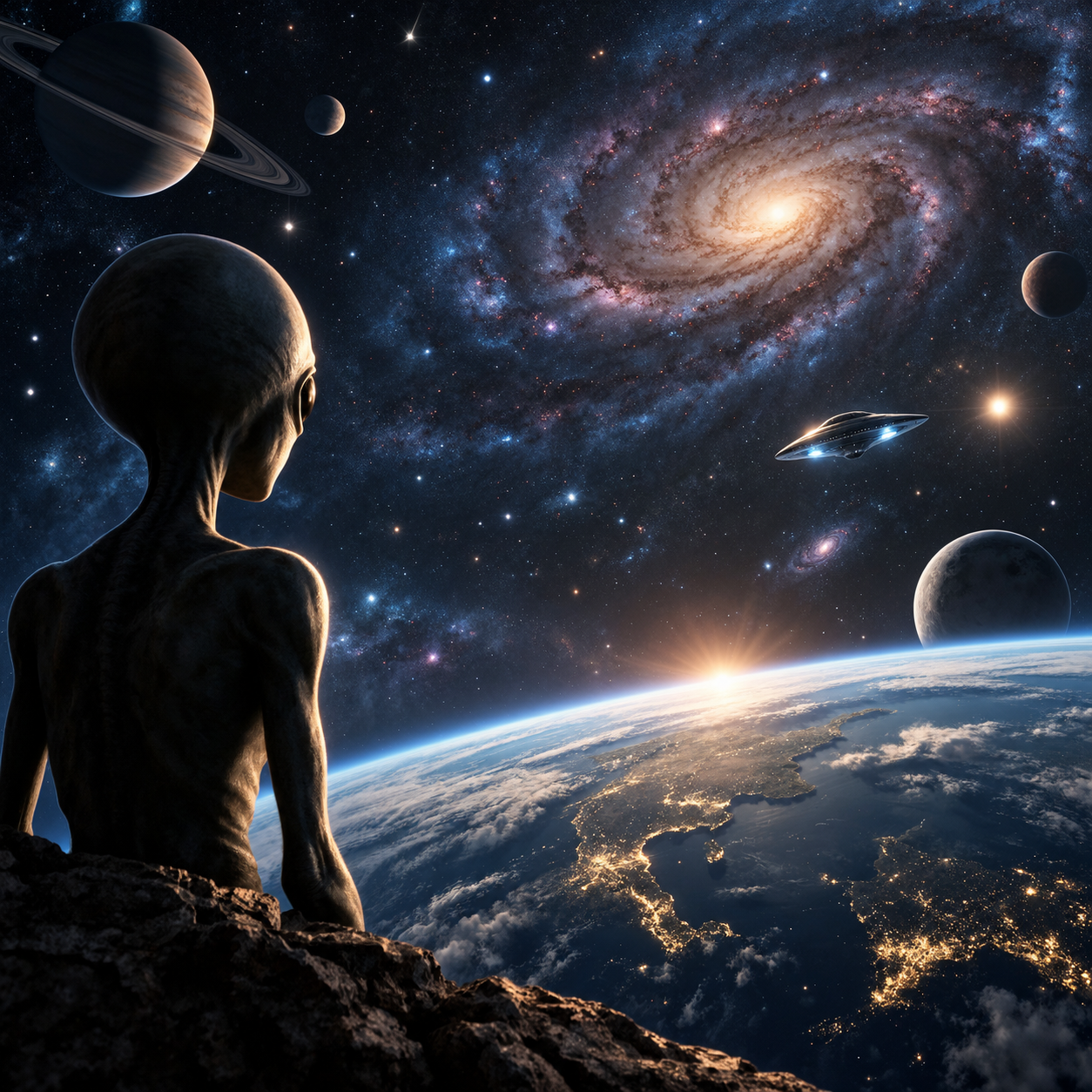
In a universe of billions of galaxies, is Earth really the only place where life emerged — or are we part of something much larger?
For as long as humans have looked at the night sky, one question has remained almost impossible to ignore:
Are we alone?
For most of history, this was primarily a philosophical question. Today, it is also a scientific one.
We now know that Earth is not sitting at the center of a small and simple cosmos. We inhabit one planet orbiting one star, inside one galaxy, in an observable universe containing an extraordinary number of galaxies, stars and planetary systems.
The scale is difficult for the human mind to comprehend.
And that scale raises a profound question: if the universe is so vast, so old and filled with so many potential environments, why should life have appeared only here?
A Universe Far Older Than Humanity
The universe is estimated to be approximately 13.8 billion years old.
Earth appeared much later, roughly 4.5 billion years ago. Human beings arrived extraordinarily late in comparison with the history of the cosmos.
Imagine compressing the entire history of the universe into a single day.
Humanity would appear only at the very end.
This perspective challenges one of our deepest intuitions: the tendency to place ourselves at the center of existence.
For centuries, humans naturally interpreted the universe from the only point of view available to them — Earth. But scientific discovery has repeatedly expanded that perspective.
Earth is not the center of the Solar System.
The Sun is not the center of the galaxy.
The Milky Way is not the center of the universe.
So another question follows naturally:
Must humanity be the only intelligent life in existence?
We simply do not know.
The Numbers Make the Question Difficult to Ignore
Our galaxy alone contains an enormous number of stars, many of which have planets.
Modern astronomy has confirmed thousands of planets beyond our Solar System, known as exoplanets. Some orbit within regions where conditions could potentially allow liquid water to exist.
None of this proves that life exists elsewhere.
A planet capable of supporting life is not the same thing as a planet containing life. And simple biological life is very different from intelligent, conscious or technologically advanced life.
Still, the discovery of planetary systems throughout our galaxy transformed an ancient philosophical question into something science can investigate.
We are no longer asking whether other worlds exist.
We know they do.
The unanswered question is what, if anything, lives on them.
The Great Silence
This leads to one of the most fascinating problems in modern thought: the Fermi Paradox.
If the universe contains so many stars and planets, and if some civilizations could have emerged millions or even billions of years before humanity, why have we found no clear evidence of them?
Where is everyone?
There are many possible answers.
Perhaps life itself is extraordinarily rare.
Perhaps simple life is common but intelligent life is rare.
Perhaps technological civilizations tend to destroy themselves before they become capable of spreading across the galaxy.
Perhaps interstellar distances are simply too great.
Perhaps advanced civilizations communicate in ways we do not recognize.
Perhaps they have no interest in communicating.
Or perhaps we have simply searched an unimaginably small fraction of the universe for an unimaginably short period of time.
The silence does not prove that we are alone.
But the size of the universe does not prove that we are not.
For now, the intellectually responsible answer remains:
We do not know.
What If Life Exists Elsewhere?
Suppose that tomorrow we discovered indisputable evidence of life on another world.
Not merely bacteria, but intelligent life.
What would actually change?
Scientifically, it would be one of the greatest discoveries in human history.
Philosophically, however, the consequences could be even larger.
Humanity would have to reconsider a deeply rooted assumption: that intelligence, consciousness and moral awareness are uniquely terrestrial phenomena.
And that raises another question.
Would discovering another intelligent species make humanity less important?
Not necessarily.
Uniqueness and value are not the same thing.
There are billions of human beings, yet the existence of other people does not make an individual human life meaningless.
In the same way, discovering another intelligent civilization would not automatically diminish humanity. It might simply place humanity within a much larger story.
An Ancient Question Hidden Inside a Modern One
Interestingly, the possibility of life beyond Earth is not exclusively a modern scientific idea.
Different philosophical, religious and cultural traditions have imagined multiple worlds, different realms of existence and forms of life beyond ordinary human experience.
One particularly interesting example appears in the Qur’an.
A passage traditionally identified as Qur’an 42:29 refers to the creation of the heavens and the Earth and to living creatures dispersed within them.
The Arabic term used in the passage, dābbah, generally refers to living or moving creatures.
This does not constitute scientific evidence for extraterrestrial life, nor would it be reasonable to present an ancient religious text as an astronomical observation.
But philosophically, the wording is interesting.
Some questions don’t need answers — just space.
Ask yoursIt does not require a universe in which biological existence is confined exclusively to Earth.
That distinction matters.
There is a significant difference between saying:
“An ancient text proves extraterrestrial life exists.”
and saying:
“An ancient text appears compatible with the possibility that life is not restricted to Earth.”
The first is a scientific claim requiring evidence.
The second is an observation about how a text can be interpreted.
Keeping those categories separate allows science, philosophy and religion to participate in the same conversation without forcing one to impersonate the other.
Are Humans the Highest Form of Creation?
Another ancient idea deserves similar examination.
People often assume that religious traditions necessarily place human beings above every other possible form of creation.
Yet the picture can be more nuanced.
For example, Qur’an 17:70 describes humanity as honoured and favoured above many of the created beings.
The distinction between “many” and “all” is philosophically interesting.
It leaves open a possibility that human beings can possess extraordinary value without necessarily representing the absolute limit of what conscious creation could be.
That idea becomes especially intriguing when considered in a universe containing billions of galaxies.
Perhaps intelligence exists at different levels.
Perhaps consciousness can emerge in forms completely unlike ours.
Perhaps another civilization could be technologically far ahead of humanity while remaining morally primitive.
Or perhaps consciousness itself has dimensions that our present scientific understanding cannot yet describe.
These are possibilities, not discoveries.
But they expose an important assumption hidden inside the extraterrestrial-life debate:
When we search for intelligent life, we tend to search for ourselves in another form.
The universe may not be obliged to satisfy that expectation.
Would They Look Like Us?
Popular culture has created a remarkably persistent image of the extraterrestrial: large eyes, unusual skin, a humanoid body and advanced technology.
There is little scientific reason to assume this.
Life elsewhere would develop under different gravity, chemistry, atmosphere, temperature, radiation and evolutionary pressures.
It could therefore look radically different from terrestrial life.
But the opposite possibility cannot be logically excluded either.
Certain physical problems may produce similar biological solutions. Evolution on Earth itself has independently produced comparable structures more than once.
So extraterrestrial intelligence could be completely unfamiliar.
Or unexpectedly familiar.
Until we find another example of life, Earth remains our sample size of one.
That is one of the greatest limitations in the entire discussion.
Perhaps We Are Asking the Wrong Question
“Are aliens real?” sounds like a simple question.
But underneath it are much deeper ones.
What is life?
What is consciousness?
Is intelligence an inevitable consequence of sufficiently complex life, or an extraordinary accident?
Does consciousness have a purpose?
Is humanity significant because we are alone, or can we remain significant even if we are not?
And perhaps the most uncomfortable question:
Why do we instinctively assume that the universe should revolve around us?
Human knowledge has repeatedly advanced by abandoning assumptions of centrality.
We once imagined our immediate surroundings represented almost everything that existed.
Then our world became one planet.
Our Sun became one star.
Our galaxy became one among countless others.
Each discovery made the physical universe larger while apparently making humanity smaller.
Yet something curious happened at the same time.
The more insignificant our physical size appeared, the more extraordinary our ability to understand that insignificance became.
A human being is tiny compared with a galaxy.
But a galaxy does not appear to wonder what it is.
We do.
The Most Extraordinary Possibility May Be Either Answer
There are two possibilities.
Somewhere in this enormous universe, other conscious beings are looking toward their own night sky and asking the same question we are.
Or they are not.
Perhaps life exists throughout the cosmos.
Perhaps intelligent civilizations have appeared many times.
Perhaps humanity is simply one young participant in a universe filled with consciousness.
But consider the alternative.
Perhaps, across billions of galaxies and billions of years, matter became capable of looking back at the universe and asking why it exists only here.
If that were true, humanity's responsibility would become almost impossible to exaggerate.
Because consciousness might be far rarer than we imagine.
At present, we have no evidence strong enough to choose confidently between these possibilities.
And perhaps that uncertainty is itself valuable.
The question forces science to explore.
It forces philosophy to examine our assumptions.
It allows ancient ideas to be reconsidered without turning them into scientific claims.
And it forces humanity to confront its place within something vastly larger than itself.
So, are we alone in the universe?
We don't know.
But whether the eventual answer is yes or no, either possibility would profoundly change how we understand ourselves.
Perhaps the greatest discovery waiting somewhere in the universe is not simply finding someone else.
Perhaps it is discovering what humanity really is.