
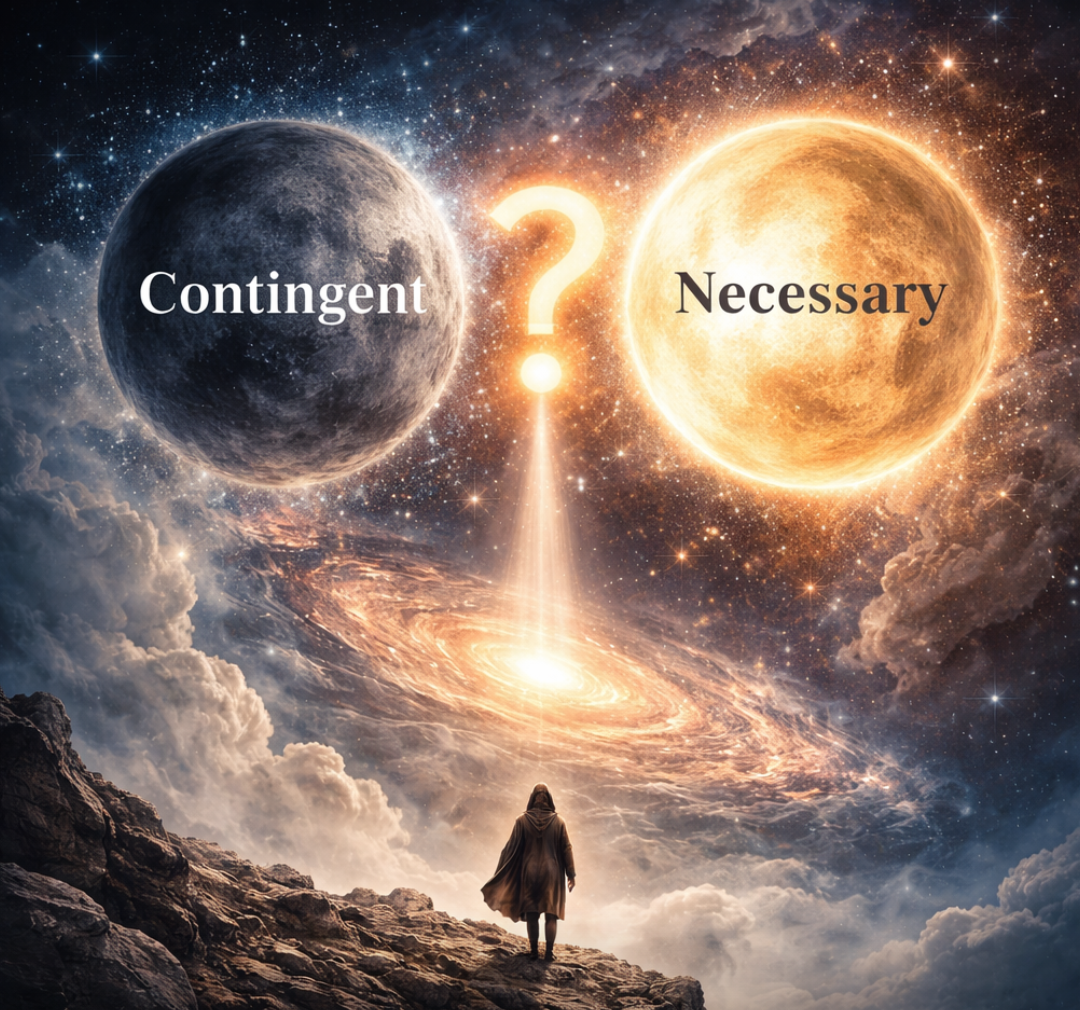
The Question of Necessary Existence
Were we—human beings and all other entities—required to exist?
Is there something that must exist, something without which nothing else could be?
What kind of reason or explanation accounts for the existence of the universe and everything within it?
Can anything be the cause of its own existence?
Is it more rational to believe that matter is self-caused, or that it rests upon a conscious and powerful ground?
These questions draw us into a classical metaphysical distinction. Many philosophers have argued that every being must belong to one of three categories:
1. Contingent Being
A contingent being is something that may exist or may not exist. Its existence is not necessary; it depends on an external cause.
2. Necessary Being
A necessary being exists by virtue of itself. It requires no external cause. One cannot coherently conceive of its non-existence. Remove a star, a person, or even a galaxy from reality and the conceptual framework remains intact. But remove the Necessary Being—if such exists—and nothing meaningful remains.
3. Impossible Being
An impossible being cannot exist under any circumstance (e.g., a square circle or a four-angled triangle).
The Chain of Causality
Contingent beings, by definition, require causes beyond themselves. Each depends upon something else for its existence. But can this chain of causes extend infinitely?
If every contingent being requires another contingent being before it, and this regress continues without end, then no being would ever actually come into existence. An infinite postponement of causes results in the impossibility of any effect.
Those who regard the universe as contingent argue that it too requires an external cause. This cause has historically been described as the Necessary Being. In Aristotle’s philosophy, it appears as the “Unmoved Mover.” In Islamic kalām theology, it is formulated as the Hudūth argument. In modern philosophy, versions of the contingency argument were defended by thinkers such as Leibniz, Richard Swinburne, and William Lane Craig.
A contingent being is something whose existence and non-existence are equally conceivable. Nothing collapses logically if it exists; nothing collapses if it does not. The entire set of empirical entities appears to share this status.
But contingent beings cannot account for themselves. A human being, for instance, depends on prior causes. Yet we cannot meaningfully posit an infinite regress of human pairs extending backward without ever reaching a foundation—because such a regress would prevent existence from ever occurring.
Some atheistic or materialist responses suggest that:
- Matter is eternal,
- Matter evolved from some prior state,
- Or existence emerged by chance.
However, affirming the eternity of matter does not automatically solve the problem. Material entities are themselves contingent—subject to change, decay, and dependence. If each material state depends on another, an infinite chain would again explain nothing.
Can the Universe Choose Itself?
Some argue that perhaps the universe itself—or some internal principle—“preferred” its own existence. Yet how could something that does not yet exist choose to exist? Choice presupposes agency, intention, and power. These are not properties of non-being.
To prefer existence over non-existence requires will and awareness. Such attributes cannot belong to something merely possible; they must belong to something whose existence is already actual and independent.
Thus, contingent beings appear to require a cause that is not contingent.
Some questions don’t need answers — just space.
Ask yoursCritiques and Modern Objections
Thinkers such as Antony Flew and Stephen Hawking have suggested that if the universe is eternal, the need to infer God disappears. If there is no beginning, perhaps there is no need for a transcendent cause.
While this objection has force within certain cosmological models, it leaves open crucial questions:
- How did rational and mathematical order arise from non-rational matter?
- How does blind physicality generate intelligibility?
- Why does the universe exhibit such deep structural coherence?
Even if the universe were eternal, its explanatory status would still be contested. An eternal contingent system does not automatically become self-explanatory.
Moreover, modern cosmology—especially Big Bang theory—suggests that the universe had a beginning. If the universe began, it cannot serve as its own ultimate explanation.
Two Options for the First Cause
When searching for the ultimate ground of existence, two principal options emerge:
- The universe (matter) is the necessary reality.
- God is the necessary reality.
Whichever option one chooses must function as self-existent and uncaused. Materialism and naturalism favor the first. Theism, deism, pantheism, and panentheism favor the second.
The central philosophical question is not merely which option one prefers, but which offers a more coherent explanation.
Did everything arise from unconscious matter over immense stretches of time?
Or did everything arise from a conscious, powerful, necessary source?
The Concept of Perfection
Descartes and Leibniz described God as the most perfect being conceivable—one beyond which nothing greater can be imagined.
If such a being were merely contingent, it would depend on something else and could fail to exist. That would contradict the idea of maximal perfection.
A necessary being, by contrast:
- Depends on nothing,
- Cannot be annihilated,
- Cannot be conceived as absent.
If God is truly the most perfect being, then God cannot be contingent. A contingent God would not be ultimate.
Therefore, within this framework, God must belong to the category of Necessary Being.
Final Reflection
The problem of contingency forces us toward a foundational choice.
Either reality ultimately rests on unconscious matter that simply “is,”
or it rests on a necessary, conscious source that grounds all contingent existence.
The debate remains open. But one conclusion emerges clearly from the structure of the argument:
If there is a God, that God cannot be a contingent being.
A contingent God would not explain existence.
Only a Necessary Being could.