
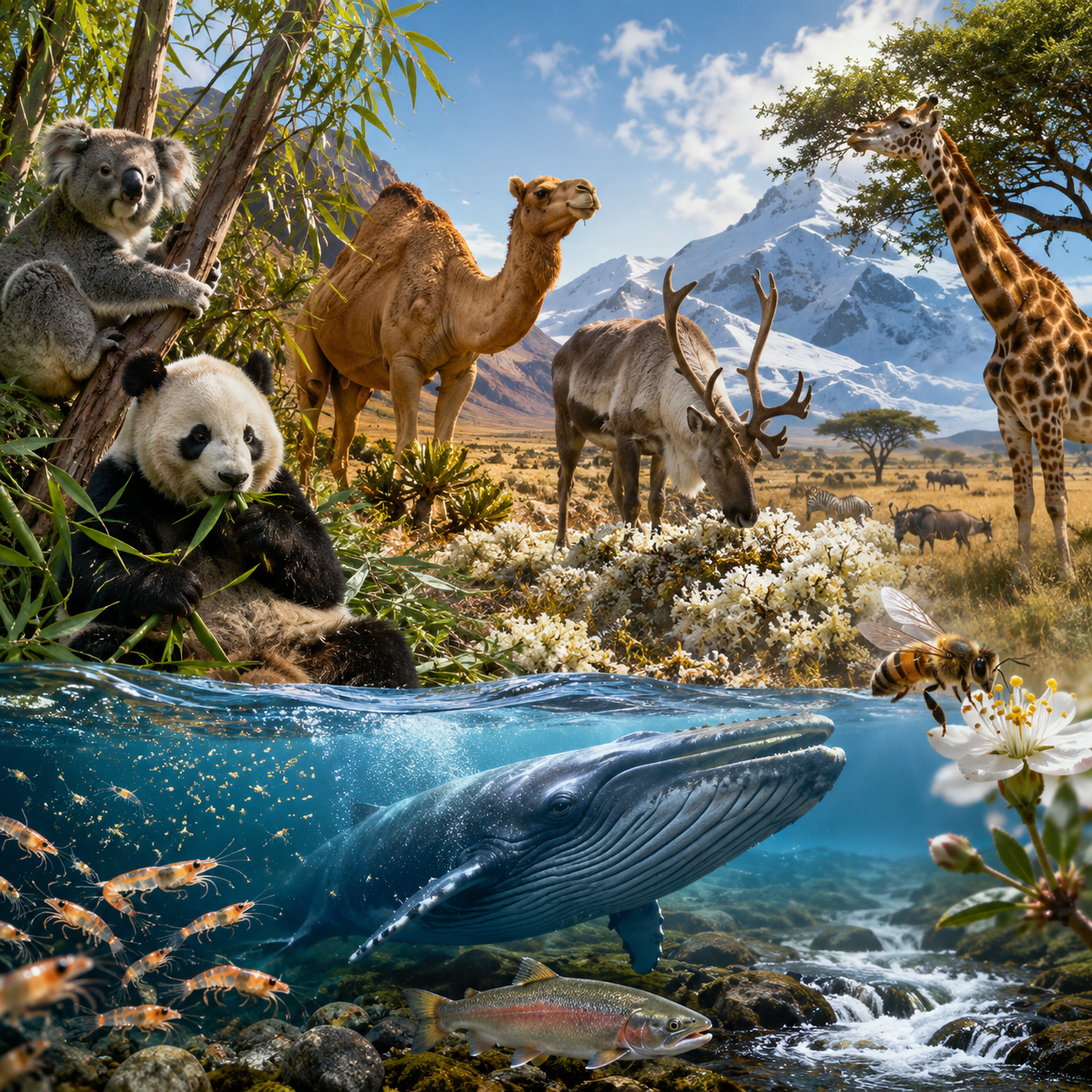
Every living organism possesses a digestive system remarkably suited to the environment in which it lives and the food available within that environment. Across the natural world, anatomy, physiology, and nutrition display a striking level of compatibility.
Camels, for example, are able to consume thorny and fibrous desert plants that would injure or be indigestible for many other animals. Their mouths, lips, and digestive systems are specifically adapted to process such vegetation.
Approximately 99 percent of a panda's diet consists of bamboo. Although bamboo is exceptionally tough, the panda's powerful jaw muscles and specialized digestive system enable it to utilize this resource efficiently.
Koalas feed almost exclusively on eucalyptus leaves. These leaves contain compounds that are toxic to most animals, yet the koala possesses specialized liver functions and intestinal microorganisms capable of detoxifying them.
Reindeer survive the harsh Arctic winter primarily by feeding on lichens. Their digestive systems host unique microorganisms that break down this nutrient-poor but abundant food source.
Likewise, giraffes possess elongated necks that allow them to reach the foliage of tall trees, while their digestive systems are adapted to process these leaves efficiently. In each case, the available food source and the biological equipment of the animal exhibit a remarkable correspondence.
Provision at the Scale of Ecosystems
The same harmony extends beyond individual organisms to entire ecosystems.
Some questions don’t need answers — just space.
Ask yoursIn the oceans, plankton—the foundation of marine food webs—is continuously produced within the sunlit surface waters. From microscopic organisms to the largest whales, countless species depend upon this ongoing biological productivity. A blue whale may consume nearly four tons of krill in a single day, whereas a bee gathers only milligrams of nectar. Despite these immense differences in scale, each organism possesses feeding structures and metabolic systems precisely suited to its nutritional requirements.
Across the African savannas, seasonal rainfall stimulates the growth of grasses that sustain large populations of herbivores. These herbivores subsequently become the food source for carnivores, maintaining the continuity of ecological food chains.
Salmon hatch in freshwater rivers, migrate thousands of kilometers through the oceans as they mature, and later return to their natal rivers to reproduce. During this extraordinary migration, they also become an essential source of nutrition for numerous terrestrial and aquatic species.
Photosynthesis on Earth generates hundreds of billions of tons of organic matter each year. Plants absorb carbon dioxide, release oxygen, and form the primary foundation of almost every terrestrial food web. Humans and animals ultimately depend upon this continuous biological production.
Tree roots absorb minerals and water from the soil, leaves capture solar energy, fungi recycle organic matter, and bacteria maintain nutrient cycles. Together they form an interconnected system involving billions of living organisms. The remarkable continuity and coordination of this global network represent one of the most fascinating subjects studied in ecology.
Modern microscopy, genetics, molecular biology, and ecological research increasingly reveal that living organisms are composed of highly integrated and extraordinarily sophisticated biological systems. Every species appears equipped with structures appropriate for its habitat, nutritional needs, and survival.
From a scientific perspective, these observations demonstrate an exceptional degree of biological adaptation and ecological compatibility. From a philosophical perspective, they invite reflection upon the remarkable order, coherence, and interconnectedness observable throughout the living world.
Within Earth's ecosystems, billions of organisms continuously obtain the nourishment required for survival, each through mechanisms uniquely suited to its biology and environment. This global harmony remains one of nature's most compelling and enduring phenomena.