
Human beings learn by acquiring new knowledge, skills, or understanding through experience, observation, and interaction. When a subject is abstract, learning becomes more difficult because opportunities for experience, observation, and interaction are limited. In such cases, people try to understand what they are curious about by comparing it with what they have previously learned and with themselves. They build analogies between new concepts and their existing knowledge and experiences.
When the subject is God, the matter becomes even more complex. Beyond the abstract nature of the topic, the main problem is this: God is a being unlike anything we have ever seen or learned before. In our desire to understand, we are forced to imagine familiar beings, enlarge them in our minds, and place them in God’s position to make comparisons. By trying to liken a being that has no equivalent to other things, we end up making mistake after mistake. While attempting to make understanding easier, we actually make it harder.
The human mind is equipped with the ability to focus on only one subject at a time. We can think about a second subject only by holding the first one in suspension. When we try to understand or listen to multiple things simultaneously, our mental “program” becomes strained. Our eyes cannot look both north and south at the same time. Our hands can touch only objects within their reach; we cannot physically contact something a hundred meters away at the same moment. If we use these limited human conditions as analogies to understand God, problems are inevitable. Even if we imagine increasing the dimensions of these limitations for God, the problem does not disappear. When the finite is compared with the infinite, the situation can never truly be resolved.
While trying to understand God, humans often imagine increasing their own capacity and then attribute this amplified capacity to God. For example, we might suppose a human who can do dozens of tasks at the same time, and then say that God can do hundreds of thousands. But in the universe there are works that are virtually infinite in number. How does God do all of them at the same time? If we pay attention, in this effort to understand, God is always being compared to some kind of being. Yet things that are not of the same kind cannot be understood by comparing them to each other. However, certain abilities displayed by objects other than humans or living beings can offer us a broader perspective in understanding God. Let us look at some examples.
Some questions don’t need answers — just space.
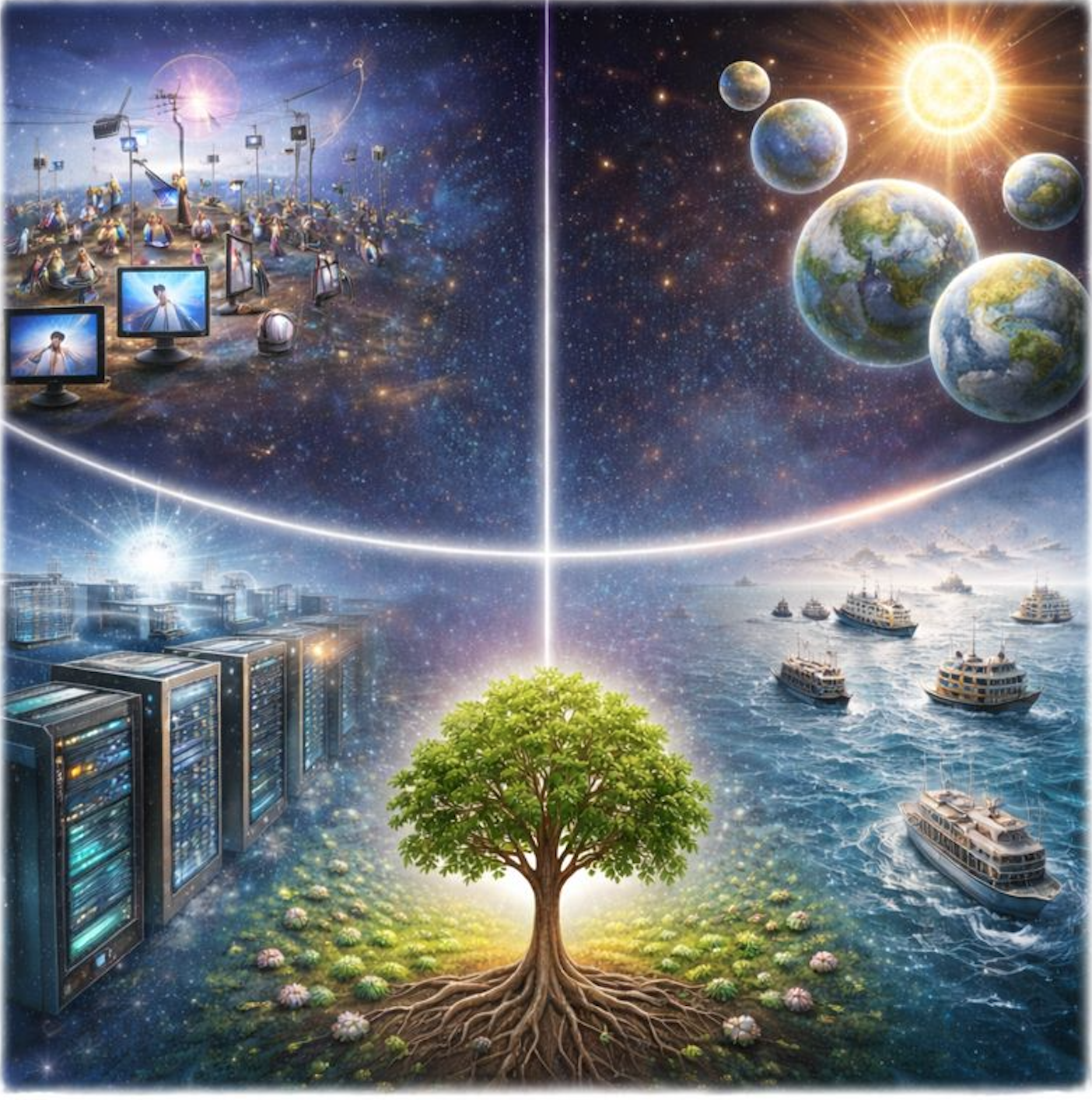
Ask yoursThe sound of a single object can reach the ears of thousands of people at the same time. With advancing technology, this number can reach billions. Through radio, television, and the internet, this number continues to increase. Even if the world’s population were to reach hundreds of billions, the ease of this process would not change. Even if there were beings on other planets and galaxies, and if technologies were developed to reach them online, these numbers would increase further, yet the act of hearing would not become more difficult. This shows that if we consider a sound as a single entity, it can reach a vast number of ears simultaneously and without strain. In other words, a single thing can perform multiple tasks with the same ease.
The sun is enormous compared to celestial bodies like the Earth. While sunlight reaches nearly countless eyes on Earth at the same time, it experiences no difficulty. Suppose there were millions of Earth-like planets with trillions of living beings; the sun’s light reaching those eyes would not become more difficult. Thus, an increase in number does not increase the degree of difficulty of the task. In fact, the sun touches every being, living or non-living, large or small, with its light without any strain. For sunlight, reaching a hundred objects or a hundred trillion objects is equally easy.
Consider today’s advanced computers. For a computer capable of performing millions of operations simultaneously, the ease of performing a single operation and performing millions of operations is the same. The atmosphere transmitting a thousand radio waves and transmitting billions of phone signals at the same time involves equal ease. A small plant delivering nutrients to all its leaves and flowers, and a giant tree delivering nutrients to all its branches and leaves, involve the same level of ease. For water, carrying a single ship and carrying thousands of ships at the same time is equally easy. Similarly, in the human body, delivering necessities to a thousand cells or to trillions of cells can be understood in the same way. When an action becomes a piece of information, and that information becomes a law, the difficulty of execution disappears.
Although these examples come from the material world, which lacks consciousness, they help us understand the ease of performing multiple actions simultaneously. God, however, cannot be a being of the kind He Himself creates; that is, He cannot be material. Therefore, beyond the ease observed in matter, it does not seem irrational that God can carry out countless actions simultaneously and without difficulty.