
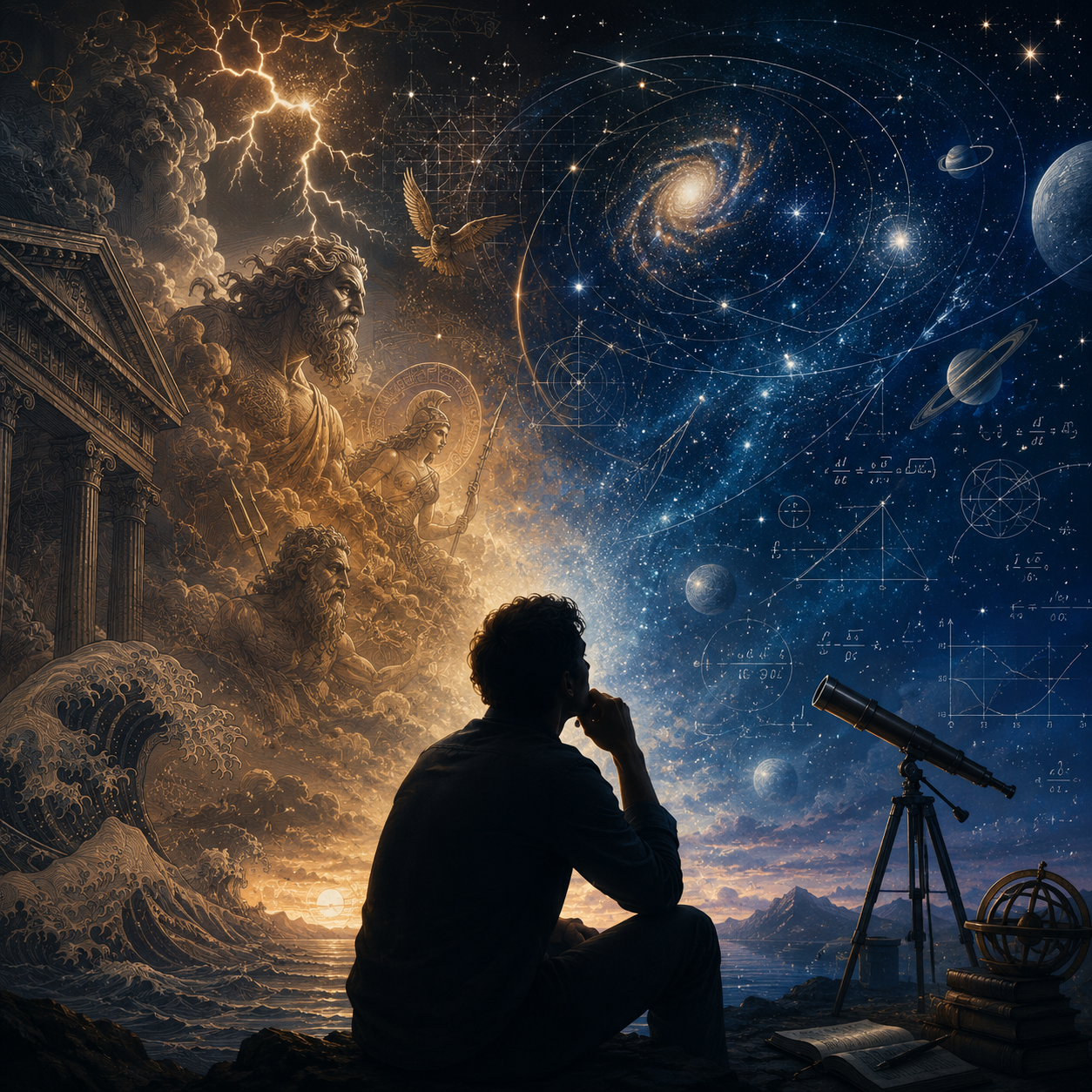
On a website that publishes articles about evolution and defends atheism through evolution, I came across the following claim:
“I think that after a certain age, people stop maturing and improving themselves. In earlier periods, the age at which people stopped developing themselves was younger, because access to knowledge was more difficult. If we go back to the Middle Ages, I do not think that the people of that time were much more mature or intelligent than children. Therefore, in order to understand the events around them, they resorted to childish stories. When lightning struck, they believed it was Zeus; when storms occurred, they believed Poseidon was angry; they believed that the home of the gods was above Mount Olympus. A childish belief requires neither questioning nor evidence. Over time, these stories became legends and later became useful material for some religions. All newly emerging religions are simply different versions of ancient stories.”
In other words, the claim is this: belief in God and religions are the work of people who could not access knowledge, who had not matured, and who, in a sense, remained like children. According to this argument, especially today, when access to knowledge is easier, people are more informed, mature, and conscious; therefore, they no longer need God or religion.
There are many aspects of this claim that could be criticized. However, in this article, I would like to focus only on the words and thoughts of scientists who lived in relatively recent times, in order to show how manipulative this argument actually is.
Johannes Kepler (1571–1630) was a German astronomer and mathematician, best known for his work on the motion of the planets. Regarding Kepler’s views on God and metaphysics, we come across the following lines:
“Kepler was a deeply religious scientist. He was among the first scientists to successfully apply mathematics to the universe, and behind this application was the belief that God had created the universe according to a mathematical plan and that human beings could understand this plan. His scientific writings were full of mystical and religious arguments.”
Stanford Encyclopedia of Philosophy, Johannes Kepler, Peter Barker & Bernard Goldstein; John Hedley Brooke, Science and Religion: Some Historical Perspectives.
Galileo Galilei (1564–1642) was an Italian mathematician, physicist, philosopher, and astronomer. Galileo, who made major contributions to the scientific revolution of the Renaissance, has also been called “the father of observational astronomy,” “the father of modern physics,” and “the father of science.”
We can find Galileo’s view of the Creator and the universe in the following expression:
“In Galileo’s eyes, God had, in a sense, written the book of nature in mathematical symbols. In other words, mathematics was the language in which God had written the universe. Like Copernicus and Kepler, Galileo also saw the laws of nature as an art of God.”
Alexandre Koyré, From the Closed World to the Infinite Universe, Johns Hopkins University Press, 1957.
Isaac Newton (1643–1727) is regarded by modern scientists as one of the most influential figures in the history of science. Let us look at what this great scientific genius said about God and the universe:
“This most beautiful system of the sun, planets, and comets could only proceed from the counsel and dominion of an intelligent and powerful Being.”
Newton, Philosophiæ Naturalis Principia Mathematica, Book III, General Scholium.
Max Karl Ernst Ludwig Planck (1858–1947) was a German physicist and the winner of the 1918 Nobel Prize in Physics. Planck developed Quantum Theory and worked on the laws of thermodynamics. He discovered the Planck constant and Planck’s law of radiation.
In his 1937 lecture titled Religion und Naturwissenschaft (Religion and Natural Science), he examined in depth the harmony between religion and science. His relevant statement is as follows:
“There can never be any real opposition between religion and science. On the contrary, they are complementary elements in the mind of every serious person.”
According to Planck, while science seeks to understand the structure of objective reality — the external world — religion determines a person’s system of values and ethical stance. Planck argued that both pursue the same goal, namely truth, through different paths.
Albert Einstein (1879–1955) was a theoretical physicist. Alongside Isaac Newton and James Clerk Maxwell, he is considered one of the most important physicists in history.
In a paper he presented at a symposium at Princeton Theological Seminary in 1941, later published in his book Out of My Later Years, Einstein emphasized that science and religion should not be seen as absolute enemies. According to him, science without a deeper moral and metaphysical horizon remains incomplete, while religion without rational inquiry and scientific awareness becomes weak.
Some questions don’t need answers — just space.
Ask yoursEinstein’s well-known reflections on the universe also show his deep curiosity about the order, intelligibility, and mathematical structure of existence. He was not merely interested in isolated physical phenomena, but in understanding the deeper rational order behind the universe. For Einstein, the laws of nature pointed to a profound intelligence and harmony that deserved serious contemplation.
Paul Adrien Maurice Dirac (1902–1984) was a British physicist and mathematician. He was one of the founders of quantum mechanics and is especially known for the Dirac equation, which explained the behavior of fermions and opened the way for the discovery of antimatter. In 1933, Dirac shared the Nobel Prize in Physics with Erwin Schrödinger.
Dirac expressed the view that the universe appears to have been constructed according to an extremely advanced mathematical order. He suggested that, if one speaks of God in relation to the universe, one may think of God as a supreme mathematician who used highly advanced mathematics in the construction of reality. He presented this idea in his 1963 article “The Evolution of the Physicist’s Picture of Nature,” published in Scientific American.
William Thomson, better known as Lord Kelvin, became a professor of physics at the University of Glasgow at the age of twenty-one and held that position for fifty-three years. He made important contributions to the study of heat and electricity. He also developed the idea of an absolute thermodynamic temperature scale, which is known today as the Kelvin scale.
Lord Kelvin believed that science did not weaken belief in a Creator, but rather supported it. In his view, the order, beauty, and harmony found in nature could not be satisfactorily explained by lifeless matter alone. He argued that deeper scientific reflection leads the human mind toward the idea of God, not away from it.
Christian B. Anfinsen Jr. (1916–1995) was an American biochemist. He won the 1972 Nobel Prize in Chemistry together with William Howard Stein and Stanford Moore for his work on ribonuclease, especially on the relationship between amino acid sequence and biologically active conformation.
Anfinsen also took a positive position toward belief in a Creator. He argued that the origin and order of the universe point toward an incomprehensible power or force possessing unlimited foresight and knowledge.
Arthur Leonard Schawlow (1921–1999) was an American physicist known for his work on lasers. In 1981, he shared the Nobel Prize in Physics with Nicolaas Bloembergen and Kai Siegbahn.
Schawlow stated that when one faces the wonders of life and the universe, it is not enough to ask only “how?” One must also ask “why?” In his view, the possible answers to this deeper question naturally open the door to religious reflection. He also said that he felt the need for God’s presence both in the universe and in his own life.
Arno Allan Penzias (1933–2024) was a German-born American physicist who won the Nobel Prize in Physics in 1978. Penzias believed that the scientific data available to us points toward creation rather than away from it.
In his view, the accumulated evidence about the universe supports the idea that the universe had a beginning and that this beginning is not easily explained by blind material processes alone. His position is often summarized as the belief that the information obtained through science is compatible with creation.
Ulrich Becker (1938–2020) was a professor of physics at the Massachusetts Institute of Technology and was also associated with the European research community in Geneva, Switzerland. Becker expressed the view that human existence cannot be properly explained without reference to a Creator.
For Becker, the question was simple but profound: how could his own existence be possible without a Creator? He stated that he was not aware of any convincing answer to this question.
John Erik Fornæss (1946– ) served as a professor of mathematics at Princeton University and the University of Michigan. Fornæss openly expressed his belief in God.
According to him, God gave structure to the universe at every level — from elementary particles to living beings, and from living systems to clusters of galaxies. In this view, the universe is not a meaningless collection of accidental events, but a reality organized through deep order and structure.
Patrick Glynn (1951– ) is a political scientist who studied at Harvard and Cambridge, two of the world’s most respected universities. He worked for many years as a political adviser during the Reagan era and was also associated with important institutions such as the American Enterprise Institute. He later served at the Institute for Communitarian Policy Studies at George Washington University in Washington, D.C.
Glynn became widely known for his 1997 book God: The Evidence — The Reconciliation of Faith and Reason in a Postsecular World. Although he had lived for many years as an atheist, he later reconsidered the scientific and philosophical evidence and came to accept the existence of God.
In his work, Glynn argued that the Anthropic Principle marked an important turning point in the history of science. For the first time, a scientific discovery did not push the human mind away from the idea of God, but rather brought it closer to that idea. For centuries, science had often been presented as if it were gradually eliminating the idea that the universe was created or designed. Yet, according to Glynn, scientists eventually encountered facts suggesting that the universe bears signs of intelligence, order, and purpose.
In his view, the countless large and small details that make life possible point toward a reality governed by wisdom and knowledge. Without such a Creator, he argued, human existence itself would not be possible.
As we can see, these extraordinary scientists and thinkers devoted their lives to research, reflection, reading, and the effort to understand the mysteries of the universe. Yet on the question of God and creation, many of them took a positive position toward belief, or at least an attitude that was open to metaphysical meaning.
It would be impossible to describe such people as individuals who failed to develop themselves intellectually or who simply stopped thinking. Therefore, belief in God or religion cannot honestly be dismissed as merely the attitude of backward people from ancient times.
To make such a claim is not a serious scientific argument. It is a generalizing and manipulative statement made in the name of atheism.
Especially when we consider the heavy intellectual pressure of the twentieth century — a period in which materialism, particularly after Darwin, became almost untouchable in many scientific circles — the courage required to express such views becomes even more significant.
For this reason, it is possible to say with confidence that science has not necessarily weakened belief in God. On the contrary, for many scientists, the deeper study of the universe has strengthened the sense that reality points beyond blind matter and toward a Creator.