
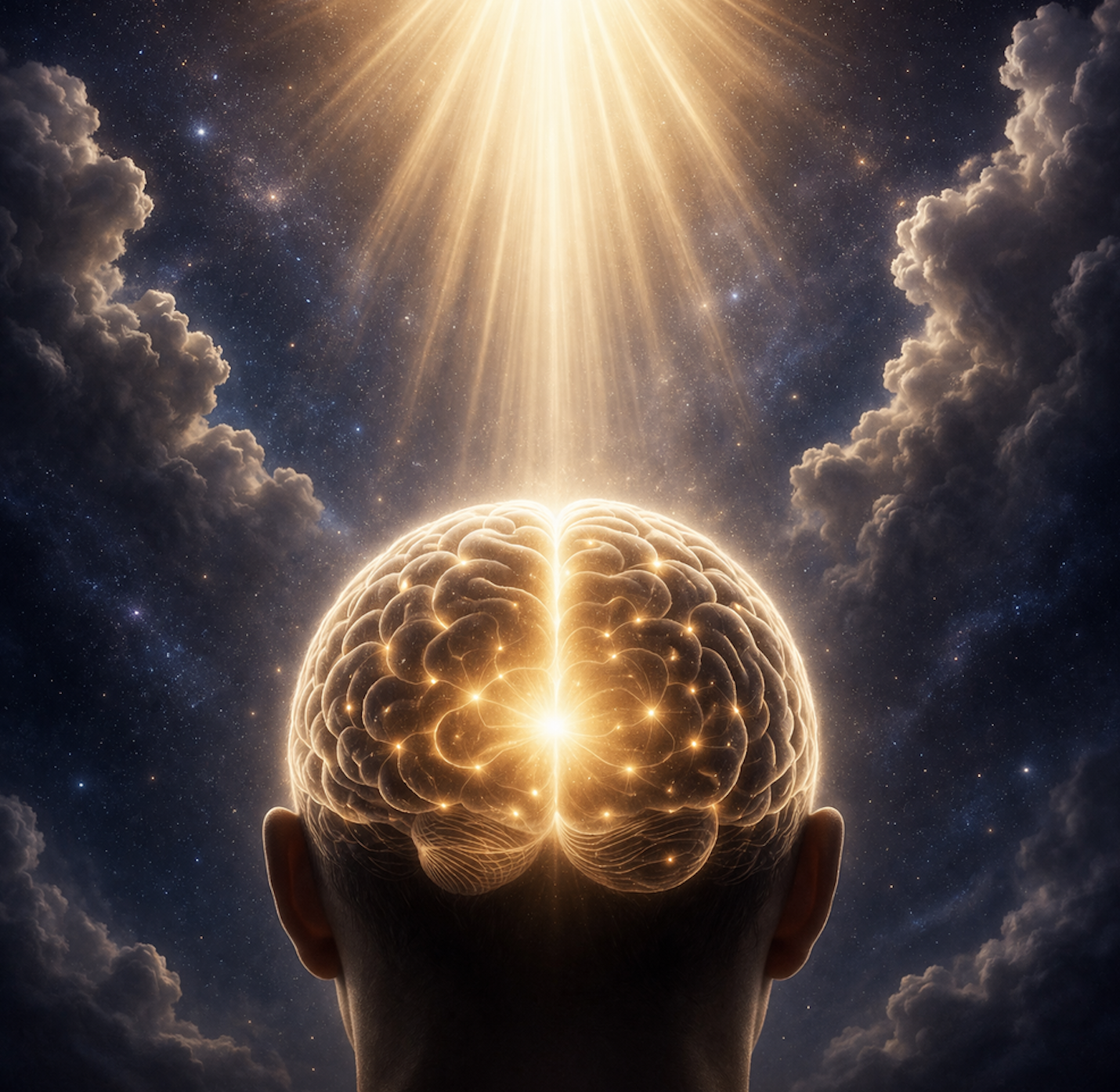
Is Consciousness Physical?
Or Does It Point to God?
One of the biggest questions in philosophy and science today is simple:
Can consciousness really be explained by physical processes?
At first, it sounds obvious. The brain produces thoughts. Neurons fire. Chemical reactions happen. So consciousness must be physical.
But that conclusion might be too quick.
The Hard Problem of Consciousness
Science has made serious progress in understanding the brain. We can track neural activity, identify regions responsible for perception, and even predict some decisions before we’re aware of them.
Still, something doesn’t add up.
Why is there any subjective experience at all?
Why does seeing red actually feel like something?
Why does pain hurt instead of just registering as information?
This is what philosophers call the hard problem of consciousness.
We can explain what the brain does.
But we can’t explain why there is an experience behind it.
No equation explains why matter becomes aware.
The Limits of Materialism
Materialism says everything is physical. According to this view, consciousness is just brain activity.
But there’s a problem here.
Brain processes are objective. You can measure them. You can observe them from the outside.
Consciousness is different. It’s subjective. It’s personal. It exists from the inside.
No brain scan, no matter how detailed, shows what it actually feels like to be conscious.
That gap is not small.
It’s fundamental.
Can Matter Produce Mind?
The standard claim is this:
Non-conscious matter, when arranged correctly, produces consciousness.
But when exactly does that happen?
- One neuron? Obviously not
- A million? Still unclear
- A billion? Why that number?
There’s no clear point where consciousness suddenly appears.
Some questions don’t need answers — just space.
Ask yoursThat’s strange.
If consciousness were just complexity, we should at least see where it begins.
But we don’t.
Another Possibility
So maybe we’re asking the wrong question.
Instead of asking:
How does matter produce consciousness?
Maybe we should ask:
What if consciousness is already fundamental?
In that case:
- Consciousness isn’t produced by matter
- Matter depends on something deeper
- The physical world isn’t the base layer
From Consciousness to God
If consciousness is fundamental, then reality starts to look very different.
The universe isn’t just blind forces and particles.
It’s grounded in something closer to mind than to mechanism.
And not just any mind.
To explain all conscious beings, this foundation would have to be:
- non-physical
- unified
- fundamental
- the source of all minds
At that point, we’re very close to what people have always called God.
Not something inside the universe,
but what the universe itself depends on.
Why This Matters
This isn’t a strict proof.
But it is a serious line of reasoning:
- If materialism can’t explain consciousness
- And consciousness clearly exists
- Then reality is not just matter
And if the foundation of reality is mind-like,
then belief in God isn’t irrational.
It actually makes sense.
Final Thought
Every experience you have is proof of consciousness.
And consciousness is still one of the least understood things we know.
The real question is not whether it exists.
The real question is:
Can a purely material universe explain it?
Or does consciousness point beyond matter…
to something deeper, and ultimately, to God?