
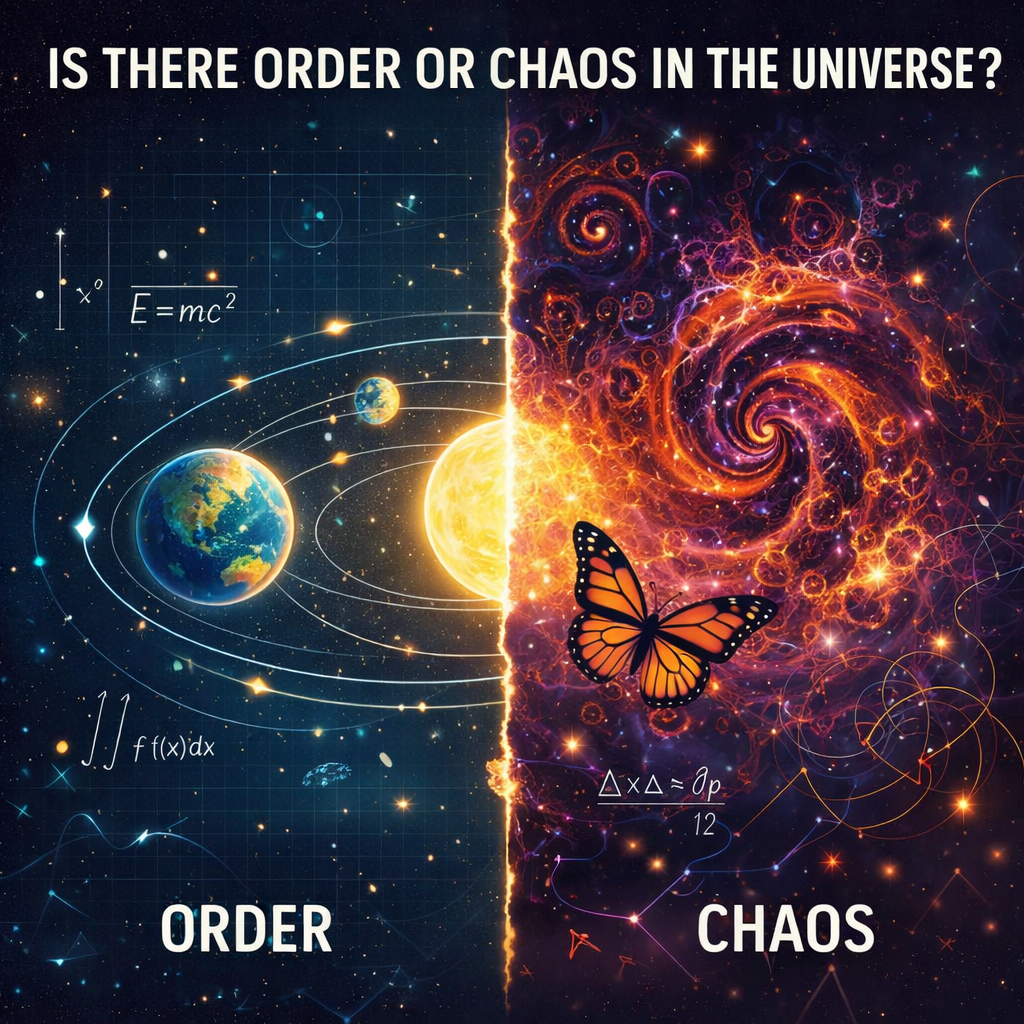
We often hear that the universe is chaotic — unpredictable, random, and full of uncertainty.
But is that really true?
Or are we simply misunderstanding what we observe?
In this article, we explore a simple but important question:
Is the universe truly chaotic, or is there an underlying order behind everything?
Some people use the word “chaos” to mean complete disorder — a state where no rules or laws exist.
Let’s consider a common argument used to support the idea that the universe is chaotic:
“We can’t know exactly what any particle will do in the future. There’s no guarantee that a meteor won’t collide with a planet or another object in space. There are countless factors and possibilities. Objects can enter each other’s gravitational fields and create chaos. There are vast numbers of stars, planets, and galaxies. Every second, collisions, interactions, and unexpected events occur. Therefore, it makes more sense to speak of chaos rather than order.”
At first glance, this may sound convincing. But on closer examination, it does not actually demonstrate chaos.
Yes, the universe contains countless events and possibilities. However, this does not mean the absence of order. For billions of years, such events have occurred — yet the universe continues to function in a stable and consistent way. We do not observe a collapse into total disorder.
A Simple Example
We can better understand this with an everyday example.
Modern cities contain millions of people. Every day, crimes occur. There are traffic jams, infrastructure issues, and occasional failures in systems such as electricity or water.
If we focus only on these problems, the situation may appear chaotic.
Yet no one seriously claims that these cities have no order at all. Why? Because the system works overall. The problems exist, but they represent only a small part of a much larger, functioning structure.
The same applies to traffic. Accidents happen regularly, but we do not conclude that there is no traffic system — only chaos.
What Science Tells Us
Science reveals something fundamental:
The universe operates according to laws.
These laws are consistent and can be described mathematically. We rely on them to develop technology, make predictions, and improve our lives. In fact, all scientific progress depends on the reliability of these laws.
This leads to a critical question:
Some questions don’t need answers — just space.
Ask yoursIf the universe had no order, how could science work at all?
A Common Contradiction
Some argue:
“The universe follows physical laws, but within those laws, it is still chaotic. Stars explode, planets collide, and black holes consume matter. If this is chaos, then the universe is chaotic.”
However, there is a clear contradiction here.
If everything operates according to laws, how can it be described as complete chaos?
This suggests that the issue is not what is happening — but how we interpret it.
What Do We Really Mean by “Chaos”?
In everyday language, when people say “chaos,” they rarely mean total lawlessness. More often, they mean that things are not perfect or that unexpected events occur.
But imperfection is not the same as the absence of order.
Consider a restaurant. If a few orders are delayed or incorrect, a customer might say, “This place is chaos.” Yet no one truly believes the restaurant has no system at all. It is simply a reaction to temporary problems.
The same misunderstanding can occur when we interpret the universe.
The Illusion of “Countless”
Another key point is the use of the word “countless.”
People say “countless stars explode” or “countless collisions occur.” But what does this actually mean?
Compared to the total number of objects in the universe — which is unimaginably vast — these events represent only a very small proportion.
The Human Body Example
Consider the human body.
It contains trillions of cells, and every day, millions of them die. If we focus only on this, we might conclude that the body is in chaos.
But clearly, this is not the case. The body continues to function, sustain life, and perform highly complex tasks.
Final Thought
So we should ask:
If a system continues to function successfully, can we truly call it chaos?
Or is it more accurate to say that there is order — even if it is not perfect?
The universe may not be perfect. Unexpected events do occur.
But imperfection is not chaos.
If laws exist, if systems continue to function, and if stability dominates over time, then what we observe is not chaos — but order with complexity.
The real question is not whether chaos exists…
But whether we are looking at the universe in the right way.