
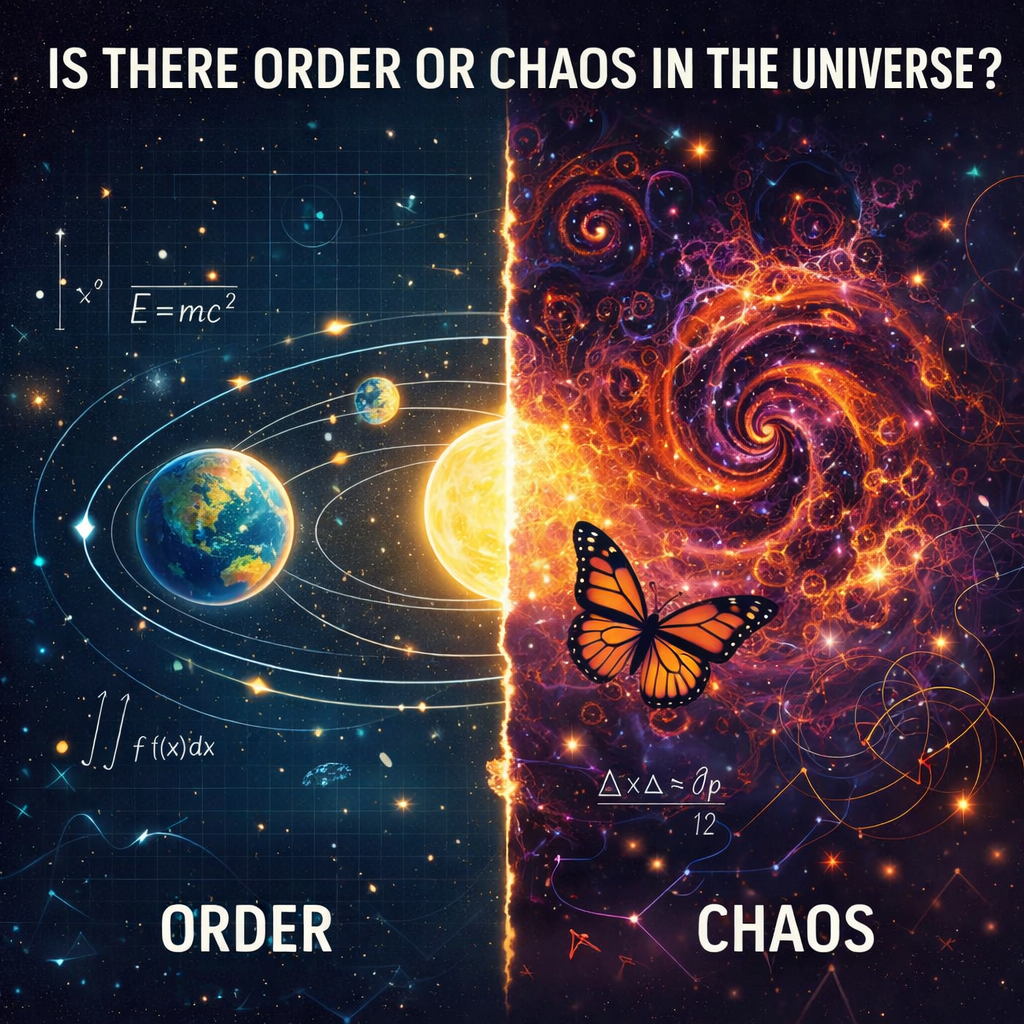
The Arguments of Those Who Use “Chaos” to Mean “Disorder” and the Absence of Law or Rules
Let us examine one of the explanations commonly used to defend the argument that “there is chaos in the universe”:
“We have no certain knowledge of what any particle in the universe will do after a certain period of time. Nor is there any guarantee that celestial bodies moving in their orbits will not be struck by an asteroid. Countless factors and possibilities can cause them to enter each other’s gravitational fields and create chaos. There are enormous numbers of celestial bodies across countless galaxies. We are speaking of a universe dense enough for anything to happen at any moment. Every second, innumerable interactions, collisions, disruptions, and deviations occur. Therefore, it makes more sense to speak of chaos rather than order.”
Now let us examine this line of reasoning more closely. Yes, there are indeed countless possibilities and events of this kind, but they do not demonstrate chaos. First of all, such accidents have been occurring in the universe and on Earth for billions of years, yet order continues. The heavens and vast galaxies are not collapsing into total catastrophe.
This can be understood more clearly through a simple analogy. Today, there are cities with populations exceeding twenty million and countries with populations in the billions. In such places, hundreds of crimes are committed every day. Infrastructure problems, congestion, interruptions in energy, water, waste management, internet systems, and natural disasters occur regularly. If one focuses only on isolated incidents, the picture may appear chaotic. Yet no one claims that these cities or countries are entirely devoid of order or governed purely by chaos. Why? Because order overwhelmingly dominates, while the events pointed to as evidence of disorder remain the minority. The existence of systems of governance, law, security, and economics is obvious both statistically and in the overall picture.
Likewise, traffic accidents and violations occur every day in any major city. Yet we do not conclude from these incidents that “there is no traffic order in this city, only chaos.”
Science tells us that laws exist in the universe and that these laws are universally valid. We then formulate these laws mathematically and use them to develop technologies that radically improve our lives. As humanity advances scientifically, the rhythm and character of civilization itself changes. We build science upon these laws and place immense trust in the discoveries made through them. As we uncover these rules, we even begin dreaming of settlements in space.
Yet despite all this, some people still turn around and ask whether the universe is governed by order or chaos, and then claim that “the universe is pure chaos, confusion, and uncertainty.”
At this point, one can hardly avoid asking those who participate in this debate while fully aware of how science functions: “Are you all right?”
The claim that the universe lacks order appears to be one of the most absurd assertions directed against science and scientists themselves. The issue here seems ideological. The strategy may be summarized as follows: in order to avoid the question “Who is the source of order?”, some atheists use the word “chaos” as a conceptual shield.
Let me quote another statement from someone who argues for chaos:
Some questions don’t need answers — just space.
Ask yours“The rules that determine the state, form, and condition of the universe are completely defined, consistent, and orderly. These are the laws of physics. However, within these laws, the universe is physically a complete environment of chaos. In our galaxy alone there are hundreds of billions of stars, systems, planets, moons, and wandering celestial objects. Every second, perhaps dozens of planets or moons are struck by asteroids. Countless stars explode, countless black holes swallow countless celestial bodies, many planets collide, countless stars steal matter from neighboring stars, and so on. If these situations fit your definition of ‘chaos,’ then yes, the universe is in chaos. But in reality, all of this complexity is simply the normal state of the universe. Even this chaotic environment continues entirely within the framework of physical laws. We cannot find a single structure acting outside the laws of physics. If you see this condition as ‘order’ — though I personally would not recommend it — then the universe is orderly. But if thousands of structures colliding, exploding, leaving orbit, or consuming one another every second means chaos to you, then the universe is full of chaos.”
Now let us analyze this understanding carefully. Consider the following sentence:
“Within the laws of physics, the universe is physically a complete environment of chaos.”
Can anyone with even a basic grasp of logic sincerely formulate such a statement?
If laws and rules exist somewhere and continue functioning, how can one simultaneously claim that there is chaos? If everything obeys the laws of physics and this is still called chaos, then there are only two possibilities: either the issue lies in our perspective, or in the meaning we assign to the word “chaos.”
Let us first consider perspective. We cannot describe the existence of countless celestial bodies and events within a galaxy as “chaos” in the sense of disorder or confusion. When the mind observes that a system functions as a whole, it recognizes order and concludes that “there is order here.” Only when failures begin to dominate does the perception of disorder gain strength.
Even then, “disorder” does not mean absolute lawlessness or total abandonment. Often, it is merely a reaction or emotional response arising from frustration. Consider a restaurant where repeated mistakes or disputes occur on the same day. Both the owner and dissatisfied customers might describe the situation emotionally as “chaos.” Yet if you then told those same people, “There is absolutely no order in this restaurant; it is completely ownerless,” almost no one would accept that claim beyond the heat of the moment. In such cases, “chaos” merely means a departure from perfection or smooth operation.
I would also like to draw attention to the repeated use of the word “countless” in the quoted text. To strengthen the argument, it is said that “countless celestial bodies collide” or are swallowed by black holes. However, the word “countless” is being used somewhat misleadingly here.
One should instead ask: What proportion of all celestial bodies do these events actually represent? Among the unimaginably vast total number of objects in the universe, what percentage do these collisions constitute?
Consider the human body. Every day, millions of cells die within a body made up of trillions of cells. Should we therefore conclude that every human body is filled with chaos and disorder? If so, then how do human beings remain alive and continue performing extraordinarily complex functions?
Can we seriously claim that all of this occurs merely “by chance” or “amid chaos and confusion” and still call such reasoning coherent and consistent?