
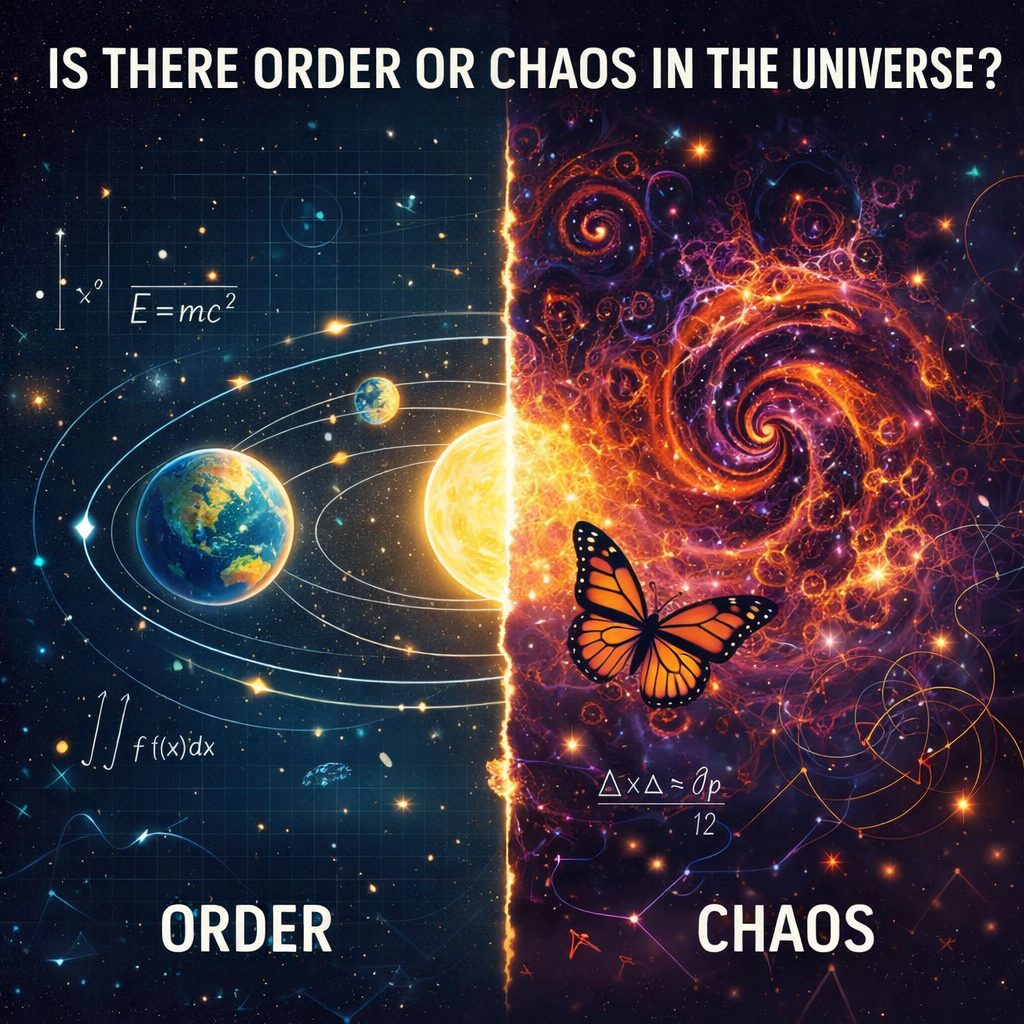
IS THERE ORDER OR CHAOS IN THE UNIVERSE?
Let us address this topic through questions and in a series of writings.
What is the literal meaning of chaos? Does “chaos theory” in science mean disorder and lawlessness?
While the word chaos in Greek means “void” or “abyss,” the French word chaos is used to mean “absolute disorder.” It is a term chosen to describe complex, disordered, and uncontrollable situations. The word implies something without rules, not bound by any law or order.
Now let us consider its meaning in science and philosophy: It is used for unpredictable and uncalculable situations in complex systems. Even if the functioning and rules are formulated with fundamental laws, due to the involvement of many factors, it is said for events whose outcomes cannot be calculated with current means.
For example, the shapes formed by cigarette smoke in the air may appear completely irregular and the product of independent random events. However, for a physicist, there are many parameters and factors behind this phenomenon. Yet, there are so many variables and influencing factors that explaining all the details and predicting the shape of the smoke three seconds later is nearly impossible. Temperature changes, the pressure differences they create, and the movement and vibrations of the smoke source continuously interact. These interactions transform into new forms in the next second, and those forms again alter the environment in unpredictable ways. The constant change of multiple inputs, creating physical changes and different patterns, and these patterns in turn affecting themselves, exceeds human intelligence and current scientific observation and prediction capabilities. Therefore, it is described as chaos. However, we do possess the physical laws and mathematical explanations that affect the shape of the smoke. “Chaos theory” was developed to describe this complexity and difficulty of calculation. With the help of very fast computers and artificial intelligence, some of what was considered chaos in the past may become calculable. Still, knowing everything seems difficult.
What is order? Is order the opposite of chaos?
It is the coming together of objects, events, or concepts within harmony, balance, and a system, in accordance with a certain method, principle, law, or purpose.
In science and philosophy, although order and chaos appear to be opposites, they are actually in a dialectical and interactive relationship; order emerges from chaos, and chaos arises from the breakdown of order. Because in scientific terms (especially in Chaos Theory), chaos is defined not as absolute disorder, but as “order within disorder” or “complex order.”
Does the butterfly effect support order or chaos?
The butterfly effect is a concept in chaos theory which states that even the smallest change in the initial conditions of a system can lead to unexpected, large, and unpredictable outcomes over time. In complex systems, there is extreme sensitivity to initial conditions. Small changes (the butterfly effect) lead to large consequences, showing that beneath seemingly chaotic events lies a mathematical order. If even micro-level changes in a system lead to vastly different and unpredictable outcomes, this indicates that it relies on extremely sensitive calculations with mathematical precision.
Scientist and mathematician Edward Lorenz was working on long-term weather forecasting using a computer simulation. One day, he ran a weather simulation with an initial value of 0.506127. When he reran it, he entered only 0.506, assuming that the last three digits would not make much difference.
Although the weather patterns initially appeared similar, he was surprised to see them diverge completely after a short time. He realized that weather has a “sensitive dependence on initial conditions”—a small difference at the beginning could lead to major changes later. As a poetic example, he later wrote that the flap of a butterfly’s wings in Brazil could trigger a tornado in Texas.
Thus, although the butterfly effect is a concept of chaos theory, it does not support “chaos” in the sense of disorder and lawlessness, since chaos in science is not used in that meaning. Its implication is unpredictable determinism. No matter how well we model a system, according to the Heisenberg uncertainty principle, there will always be a small margin of error, causing our predictions to yield incorrect results.
Does chaos or order dominate the universe?
As explained above, the claim “there is chaos in the universe” by atheists does not correspond in science to “disorder and lawlessness.” However, when certain events do not follow rules, disorder arises. The key point is that this disorder does not dominate the entire system. For example, if a dish burns or plates break in a restaurant kitchen, there is momentary chaos (in the dictionary sense of disorder). But based on these local and limited events, one cannot say that “chaos dominates” the entire kitchen or restaurant. Despite this temporary disorder, the kitchen and restaurant continue to operate and serve food.
Atheist scientists who do not turn atheism into an ideology do not claim that “chaos dominates the universe.” They know best that the universe operates based on laws of causality (determinism). If chaos truly dominated the universe, no scientific activity would be possible. In a place where rules constantly change, neither laws, formulas, nor even the smallest predictions could be made. However, in fields such as physics, chemistry, biology, and medicine, laws can be established and phenomena can be analyzed thanks to constants. We can predict and even calculate events such as seasons, the precise movements of the Earth and the Sun, the formation of living beings, the diagnosis and treatment of diseases, and weather forecasts. We can solve problems based on these calculations. This shows that even if there are elements of disorder, what governs the universe is order and laws.