
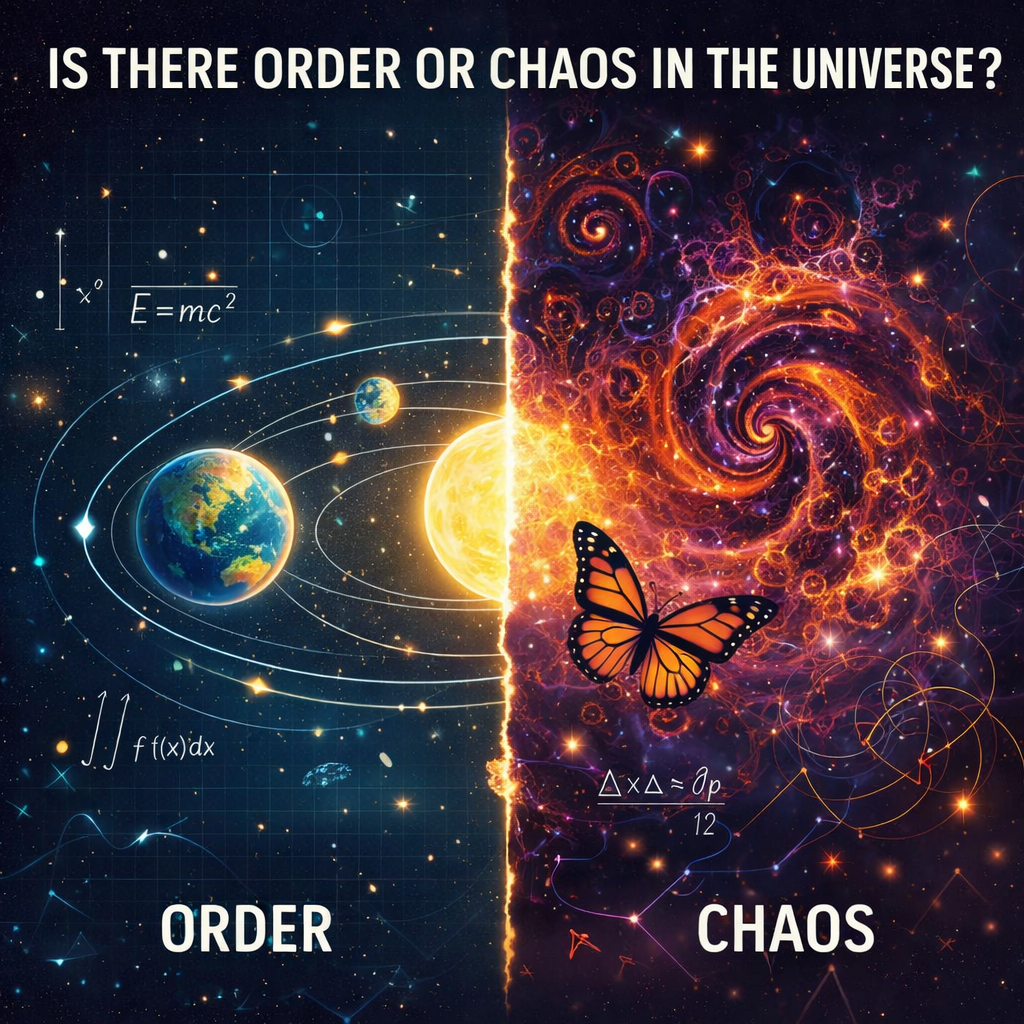
If chaos dominated the universe, would it be possible to do science?
Humanity carries out what we call science by accumulating experience and work over centuries—building layer upon layer. The splitting of the atom and the creation of nuclear weapons were not achieved solely through the efforts of scientists alive today. The mission to the Moon was not accomplished only with the knowledge and work of the last century. We do not owe the invention of the steam engine merely to the sweat of 18th-century scientists. All developments are the result of centuries of accumulation and the labor of thousands of people, and we all know this.
But if there were chaos in the universe in the sense of disorder and randomness, how would such accumulation be possible? If the laws and constants of matter or the universe did not exist, how could humanity accumulate experience? If the order changed every day or every year, how could what Newton discovered be useful to Einstein? What use would al-Khwarizmi’s algebra and algorithms have been in later centuries? Yet today, even the term for the logic used in artificial intelligence algorithms comes from “Algorismi,” the Westernized form of al-Khwarizmi’s name.
If randomness and arbitrary order prevailed in the universe, how could we calculate a solar eclipse years in advance? Or how could we track the distance and trajectory of meteors approaching Earth?
The term “chaos” in chaos theory actually stems from our inability to calculate highly complex, multi-variable factors. However, when we are able to perform such multi-variable calculations, we repeatedly observe that everything everywhere is subject to deterministic laws.
Some questions don’t need answers — just space.
Ask yoursWhy do some scientists and atheists claim that chaos exists?
Atheists with rigid and ideological perspectives are certainly aware of how firmly the universe is governed by fixed laws. However, instead of saying “chaos dominates and is effective in the universe,” they play a word game by saying “there is chaos in the universe.” People who hear this and are unfamiliar with “chaos theory” in science interpret it as meaning there is disorder and confusion everywhere. In this way, they aim to create doubt about the existence of God.
They point to black holes swallowing stars or celestial bodies occasionally leaving their orbits and colliding, claiming that there is chaos and disorder in the universe. Or they refer to the entropy-based structure of the universe, suggesting that laws of decay and destruction prevail everywhere. This is a cunning tactic: mentioning something true and then attaching false implications to it. Let’s explain this with an example:
Imagine someone giving a tour of a multi-story, intelligent building to a group of people. If they want to praise the building, they will talk about its order, managed by dozens of computerized smart systems, and give examples. If they want to criticize it, what can they do? They will point out trash in certain areas, a leaking faucet, or machines not working due to an electrical fault. Then they will say, “Look, because of these faults and irregularities, there is chaos in this building.” Yes, in such a large building, even if it is intelligent, there will of course be some malfunctions. But to claim that there is chaos in the building, one would at least need to show more disorder than order. When trying to deceive, they list 10 faults and attempt to portray 1,000 properly functioning systems as flawed. The claim that there is chaos in the universe by atheists is similar to this.
Or consider someone trying to discredit an institution that has sent vehicles or satellites into space. They might list a series of minor issues and then claim there is chaos there. Yes, there may be 10 minor problems: a cleaning issue in one restroom, a malfunction in the hot water system, or an employee falling ill and not coming to work. But if that organization has successfully sent vehicles into space, no one should believe the claim that it is chaotic. However, humans are beings easily influenced by a barrage of information and can quickly change their opinions. To counter this manipulation, it is enough to say: since this institution has launched so many satellites and spacecraft, chaos cannot dominate there. We can think of the claim that there is chaos in the universe in the same way.