
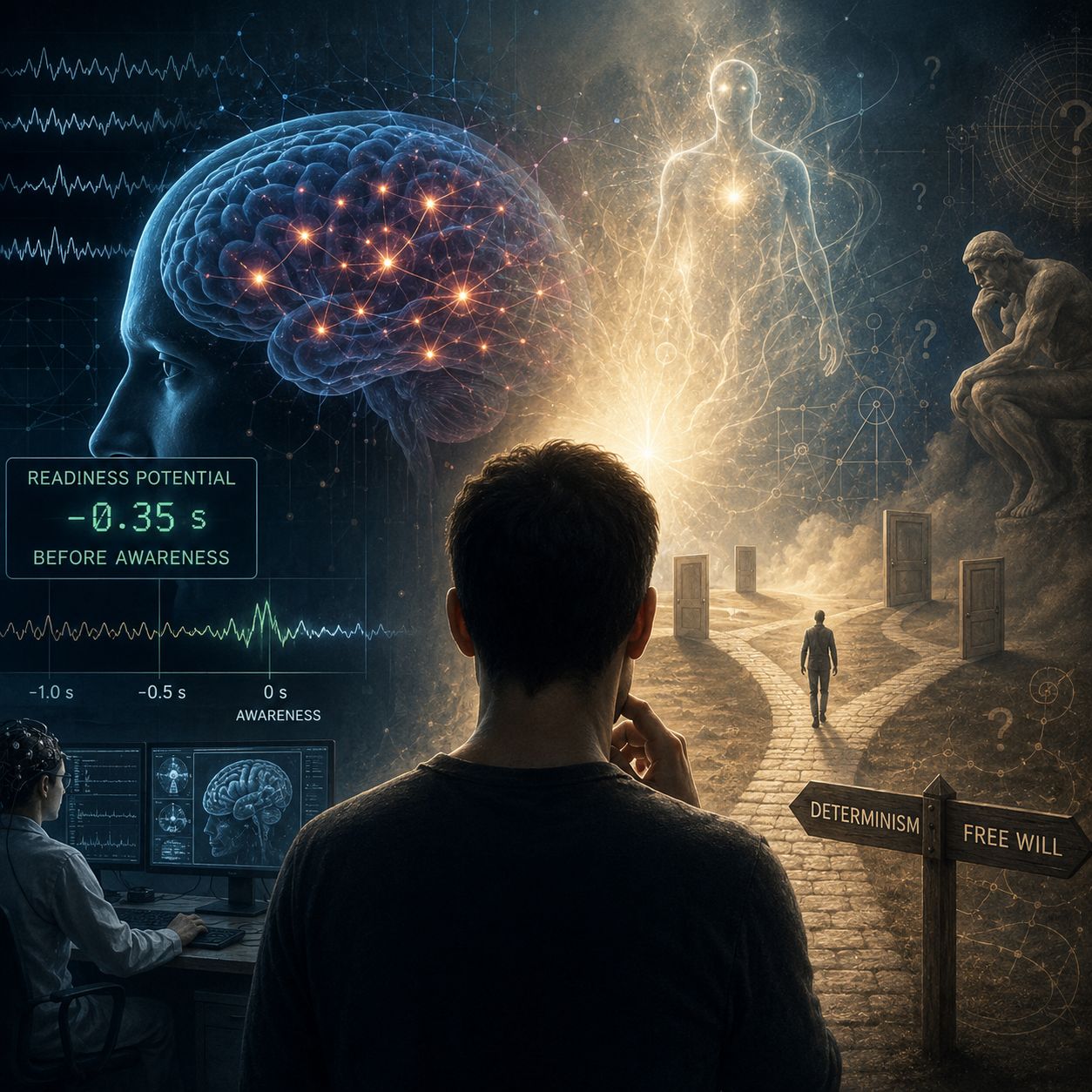
Are We Really Making Our Own Decisions?
Imagine making a decision.
You decide to raise your hand, stand up, or simply move your finger.
We know that our muscles, nervous system and brain are involved in producing this movement.
But the real question lies one step earlier:
What initiates this process in the first place?
And more importantly:
When we say, “I made this decision,” what exactly is this “I”?
This question leads us into one of humanity’s oldest mysteries — one that stretches from neuroscience to philosophy, from the problem of consciousness to the concept of the soul that human beings have debated for thousands of years.
Why Did Humanity Develop the Concept of a “Soul”?
The idea of the soul is far older than the modern age.
For thousands of years, human societies have reflected on death, the body, consciousness, and whether human existence consists solely of the physical body.
The ritual burial of the dead and ancient ideas about existence beyond death suggest that throughout history, human beings have sought some distinction between the body and the “self.”
Different civilizations and schools of thought offered different answers to this mystery.
Some understood the soul as something capable of existing independently of the body.
Others described it as the essence of life or the true self of a human being.
Modern science took a different path:
It began investigating physical processes that could be measured.
And as we began studying the human brain, an ancient question returned in a new form:
What actually determines our actions?
We Believe We Are Free. But Are We?
The problem of free will is much older than neuroscience.
For centuries, the fundamental question has been remarkably simple:
If every event in the universe is the result of events that came before it, why should human decisions be exempt from this chain?
A decision you make today may be the result of:
your genetic makeup,
your childhood,
your past experiences,
your environment,
the chemical and electrical processes taking place in your brain at that moment,
and countless events that occurred before any of them.
If all of these factors determine your decision:
Could you really have acted differently?
This brings us to the problem of determinism.
Free will, on the other hand, proposes that human beings can genuinely choose between real alternatives.
For thousands of years, this debate belonged largely to philosophy.
Until we began measuring what the brain does while a person is making a decision.
Does the Brain Act Before We Do?
In the 1980s, neurophysiologist Benjamin Libet and his colleagues investigated the electrical activity occurring in the brain during voluntary movements.
The basic idea behind the experiment was relatively simple.
Participants were asked to perform a simple movement whenever they wished.
At the same time, their brain activity was measured, and they were asked to report the moment at which they first became consciously aware of the urge or intention to move.
The result was striking.
Brain activity known as the readiness potential, associated with movement preparation, could begin several hundred milliseconds before participants reported becoming consciously aware of their intention to move.
In simplified form:
Preparatory brain activity begins.
↓
The person becomes aware of the intention to move.
↓
The movement occurs.
And this raises a deeply unsettling question:
Did “I” really make the decision?
Or had the decision-making process already begun in my brain, with consciousness becoming aware of it only afterward?
Did the Libet Experiment Prove That Free Will Does Not Exist?
No.
This distinction is extremely important.
Libet’s experiments have sometimes been interpreted as:
“Science has proven that free will does not exist.”
But the experiment did not prove this.
What was observed was a particular pattern of brain activity occurring before a simple, spontaneously initiated movement.
Whether this means:
“The brain had already made the final decision”
is a separate question.
Later research proposed alternative interpretations of the readiness potential.
According to some models, the signal does not necessarily represent a hidden decision that has already been made. Ongoing neural fluctuations in the brain approaching a particular threshold may also generate this kind of preparatory activity.
A more scientifically cautious statement is therefore:
Measurable processes in the brain can begin before we report conscious awareness of an intention to move.
That is not the same as saying:
“The brain makes our decisions for us.”
So What Initiates the First Movement?
Now let us trace the process backward.
You move your finger.
The finger moves.
↑
A signal reaches the muscles.
↑
The nervous system carries the signal.
↑
Neural activity occurs in the brain.
↑
What lies at the beginning of this chain?
Neural activity itself consists of physical processes.
Neurons operate through electrical and chemical mechanisms.
Science is becoming increasingly capable of describing these mechanisms in extraordinary detail.
But we need to distinguish between two different questions.
The first is:
How does a neural process physically begin?
The second is:
How does that physical process become the conscious experience of making a decision?
The second question takes us directly into the problem of consciousness.
Who Is the One Saying, “I Made That Decision”?
A neuron can fire.
A neural network can process information.
A signal can be sent to the muscles.
Some questions don’t need answers — just space.
Ask yoursBut alongside all of this, something else happens:
We are aware of it.
A decision does not merely occur.
We say:
“I made that decision.”
Pain is not merely a signal travelling through the nervous system.
We feel pain.
A colour is not merely a particular wavelength of light.
We see that colour.
Our brains do not merely process alternatives.
We experience ourselves as choosing.
And we believe there is an:
“I”
experiencing all of this.
How this subjective experience emerges from the electrical and chemical activity of billions of cells in the brain remains one of the most difficult questions in the study of consciousness.
Where Does the Soul Fit Into This Discussion?
This is where the concept of the soul, used by humanity for thousands of years, becomes interesting again.
We do not possess experimental scientific evidence proving the existence of a soul.
But from a philosophical and metaphysical perspective, a question can still be asked:
Could consciousness or free will have a non-physical dimension?
Under such a view, the soul would not be another physical organ located somewhere inside the brain.
It would instead be understood as a non-physical aspect associated with human identity, consciousness or will.
We could take the metaphysical hypothesis one step further:
Could a non-physical element play some role in initiating a physical process?
It is an intriguing possibility.
But the boundary must be drawn clearly:
This has not been scientifically demonstrated.
There is currently no experimental evidence allowing us to conclude that “the soul initiates the first neural activity.”
It therefore remains a metaphysical hypothesis, not a scientific finding.
Could Something Non-Physical Affect the Brain?
If we assume that a non-physical element can influence the brain, another series of questions immediately appears.
Where would this interaction occur?
How would it influence a neuron?
Would it produce a measurable physical change?
Would there be an exchange of energy?
And perhaps most importantly:
Could we design an experiment capable of testing it?
This is the crucial point from a scientific perspective.
The fact that an idea is logically possible does not mean that it is scientifically established.
A scientific hypothesis must be testable.
At present, we do not have reproducible experimental evidence demonstrating that a soul initiates neural processes.
Is Anything Science Cannot Explain Automatically Metaphysical?
No.
This distinction is equally important.
The fact that science cannot currently explain a mechanism completely does not prove that the mechanism must have a metaphysical cause.
Throughout the history of science, many phenomena that were once unexplained were later understood through natural mechanisms.
But the reverse point also matters:
We cannot make an unsolved problem disappear by pretending that it has already been solved.
Fundamental questions about consciousness remain.
We can observe processes in the brain in increasingly fine detail.
Yet the question of how the brain’s physical activity gives rise to subjective experience remains the subject of substantial scientific and philosophical debate.
Perhaps the Real Mystery Is Not the Soul, but Consciousness
A computer can process information.
A camera can record an image.
A sensor can measure temperature.
The human brain also processes extraordinary amounts of information.
But human beings possess something else alongside information processing:
Experience.
We do not merely detect wavelengths of light.
We see red.
Our nervous system does not merely report tissue damage.
We experience pain.
Our brain does not merely process alternatives.
We feel that we are making a decision.
And we believe there is an “I” experiencing all of it.
How this subjective experience of the self emerges from physical processes in the brain remains one of the hardest problems in consciousness research.
Could “Soul” Be an Ancient Name for the Problem We Now Call Consciousness?
An intriguing but unanswered question emerges here:
Could there be a connection between what humanity has described as the “soul” for thousands of years and what we now investigate as the problem of “consciousness”?
We do not have scientific evidence showing that they are the same thing.
Yet there is a striking similarity between the questions.
In the past, human beings asked:
“What gives the body life and a sense of self?”
Today we ask:
“How does physical activity in the brain produce subjective consciousness?”
The language has changed.
Our methods of investigation have advanced enormously.
But part of the mystery remains.
SOURCEONE | WHAT WE KNOW
According to current experimental findings, measurable neural processes can begin before we report conscious awareness of an intention to move.
This is an important finding.
But it does not mean:
“Free will does not exist.”
SOURCEONE | WHAT WE ARE DEBATING
What these neural processes mean for free will remains disputed.
Is consciousness the origin of a decision?
Is it one component within the decision-making process?
Or is it an observer that becomes aware of processes already taking place in the brain?
These are questions not only for neuroscience, but also for philosophy.
SOURCEONE | WHAT WE STILL DO NOT KNOW
We still do not fully understand how subjective conscious experience emerges from physical activity in the brain.
The place of the soul within this explanation is not a scientific conclusion.
It remains a metaphysical possibility.
Therefore, both of the following claims go beyond the available evidence:
“Science has proven that free will does not exist.”
and
“Science has proven that the soul exists.”
At present, we can establish neither.
SOURCEONE | THE OPEN QUESTION
Perhaps this is the most interesting part of the debate.
For thousands of years, humanity has asked:
“What gives a body its sense of self?”
Modern neuroscience now faces the question:
“How does subjective consciousness emerge from physical processes in the brain?”
We cannot say that these are exactly the same question.
But neither can we ignore their resemblance.
Today, we can investigate how the brain works in greater detail than at any previous point in human history.
And yet we still do not have definitive answers to questions such as:
Why are we conscious?
What exactly is the “self”?
Can we genuinely make free choices?
And perhaps the most unsettling question remains the simplest:
Did you really decide to read this article?
Or had your brain already begun making that decision before you became aware of it?
References
Benjamin Libet, Curtis A. Gleason, Elwood W. Wright & Dennis K. Pearl
Time of Conscious Intention to Act in Relation to Onset of Cerebral Activity (Readiness-Potential) — Brain, 1983.
Aaron Schurger, Jacobo D. Sitt & Stanislas Dehaene
An Accumulator Model for Spontaneous Neural Activity Prior to Self-Initiated Movement — Proceedings of the National Academy of Sciences, 2012.
Aaron Schurger, Pengbo Hu, Joanna Pak & Adina L. Roskies
What Is the Readiness Potential? — Trends in Cognitive Sciences, 2021.
SourceOne.world
What science knows. What philosophy asks. What we still cannot answer.
Editorial Note: This article distinguishes between experimental scientific findings, philosophical questions and metaphysical possibilities. Metaphysical explanations are not presented as scientifically established facts.