
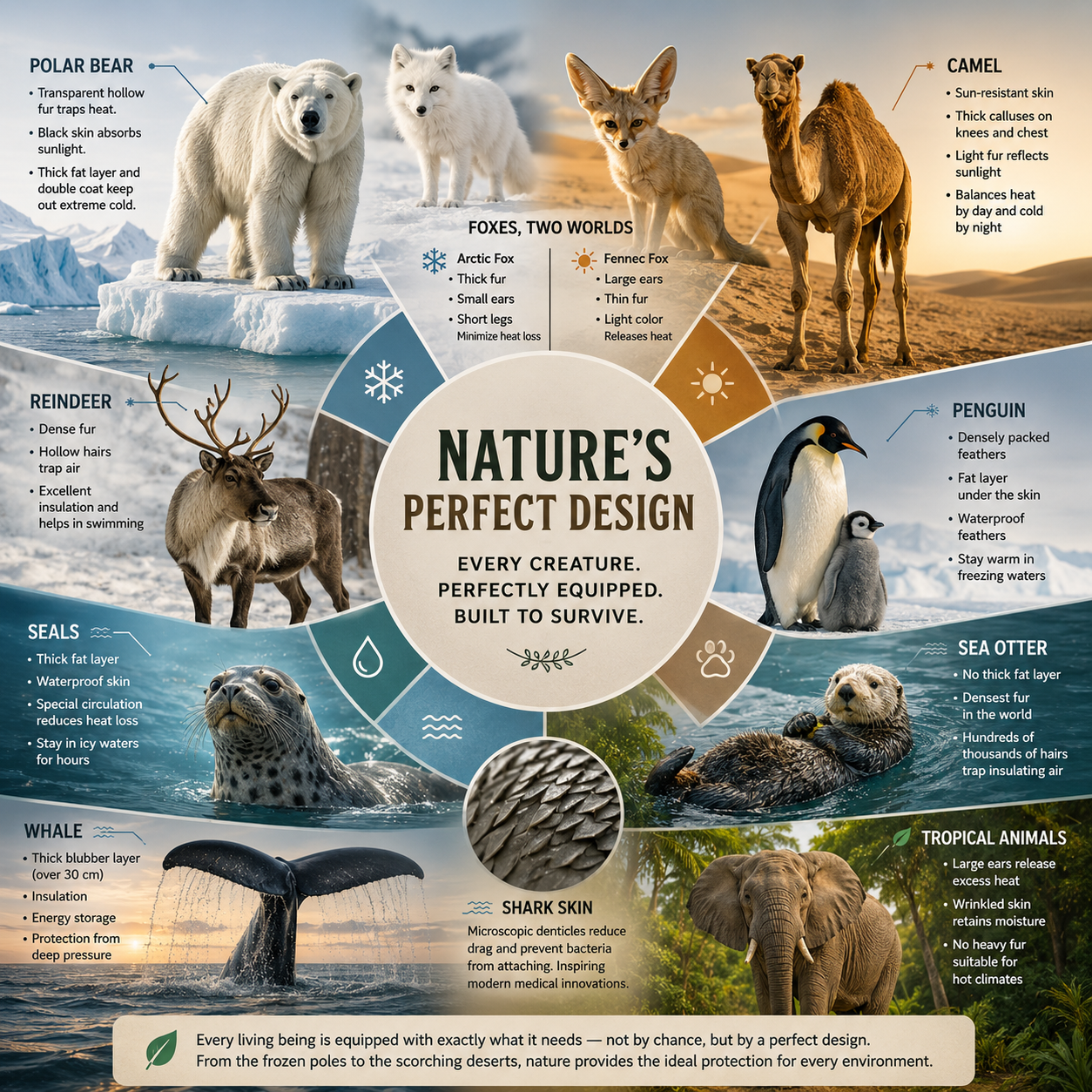
The skin, fur, fat layers, feathers, and scales found in animals are not merely coverings. They are highly specialized protective systems designed according to the environment and climate in which each creature lives. These features enable every animal to survive and remain healthy under its natural living conditions.
Polar Bears
Although a polar bear's fur appears white, each individual hair is actually transparent, while the skin beneath is black. This remarkable combination traps up to 90% of incoming sunlight, creating a thermal insulation system that is even more efficient than many of today's advanced insulation technologies. As a result, polar bears can survive temperatures below –40°C.
Their cold-weather protection includes:
- A fat layer beneath the skin that can exceed 10 cm in thickness.
- A double-layered fur coat.
- Hollow hairs that trap air and provide outstanding insulation.
- Dark skin that absorbs solar radiation more efficiently.
If these same characteristics were given to an animal living in Africa, they would cause severe overheating rather than protection.
Arctic Fox and Fennec Fox
Comparing the Arctic Fox with the Fennec Fox reveals how perfectly body structures match different climates.
Arctic Fox
- Very thick fur
- Small ears
- Short legs that minimize heat loss
Fennec Fox
- Extremely large ears
- Thin fur
- Light-colored skin that helps reduce body temperature
Although closely related, these two fox species possess body structures specifically suited to the climates in which they live.
Camel Skin and Desert Adaptation
Camels possess several remarkable adaptations that allow them to survive extreme desert conditions.
Their protective features include:
- Skin highly resistant to intense sunlight.
- Thick calloused pads on the knees and chest.
- Light-colored fur that reflects solar radiation.
- Fur structured to reduce daytime heat while limiting heat loss during cold desert nights.
Reindeer
Reindeer inhabit Arctic regions where temperatures remain extremely low.
Their protection includes:
- Exceptionally dense fur.
- Air-filled hairs that provide excellent insulation.
- A fur structure that not only conserves heat but also improves buoyancy while swimming.
Seals and Sea Lions
Harbor seals and many other seal species spend their lives in icy waters without freezing.
This is possible because of:
- Thick layers of insulating fat.
- Waterproof skin.
- Specialized circulatory systems that minimize heat loss.
While a human would develop hypothermia within minutes under similar conditions, seals can remain in these waters for many hours.
Some questions don’t need answers — just space.
Ask yoursWhales
Blue whales and many other whale species possess blubber layers that can exceed 30 cm beneath the skin.
This layer serves several essential functions:
- Thermal insulation
- Long-term energy storage
- Protection against the immense pressure found in deep water
Shark Skin
The microscopic structures on shark skin, known as dermal denticles, do far more than reduce drag in the water. They also inhibit bacterial attachment.
Inspired by this natural design, modern technology has developed surfaces that imitate these structures to help reduce hospital-acquired infections.
Penguins
The Emperor Penguin survives one of Earth's harshest climates in Antarctica.
Its protection includes:
- Extremely dense feathers
- A thick insulating fat layer beneath the skin
- Waterproof feathers
Despite constant exposure to freezing seawater, penguins are able to maintain a stable body temperature.
Sea Otters
Unlike most marine mammals, sea otters do not rely on a thick fat layer for insulation.
Instead, they possess:
- One of the densest fur coats in the animal kingdom.
- Hundreds of thousands of hairs within a single square centimeter.
- Air trapped inside the fur, creating an exceptionally effective insulating barrier.
Animals of Tropical Regions
An elephant living in Africa does not have thick fur.
Instead, it possesses adaptations appropriate for hot environments:
- Large ears
- Extensive blood vessels in the ears that release excess body heat
- Wrinkled skin that helps retain moisture for longer periods
The heavy insulating fur of a polar bear would become a disadvantage rather than an advantage under tropical conditions.
Conclusion
No living creature has acquired these highly specialized protective systems through its own ability or effort. Polar bears possess thick fur and insulating fat layers; camels have skin adapted to intense desert sunlight; seals have waterproof protective systems; penguins are equipped with dense insulating feathers; and desert foxes have large cooling ears.
What is especially remarkable is that every skin, fur, feather, or protective structure is precisely suited to the temperature, humidity, wind, hunting behavior, and environmental conditions of the region in which that creature lives.
It is as though the environment was first prepared, and then each living being was provided with the protective clothing necessary to survive within it.
This presents a remarkable picture in which every living organism appears equipped in advance with the features required for its particular way of life.