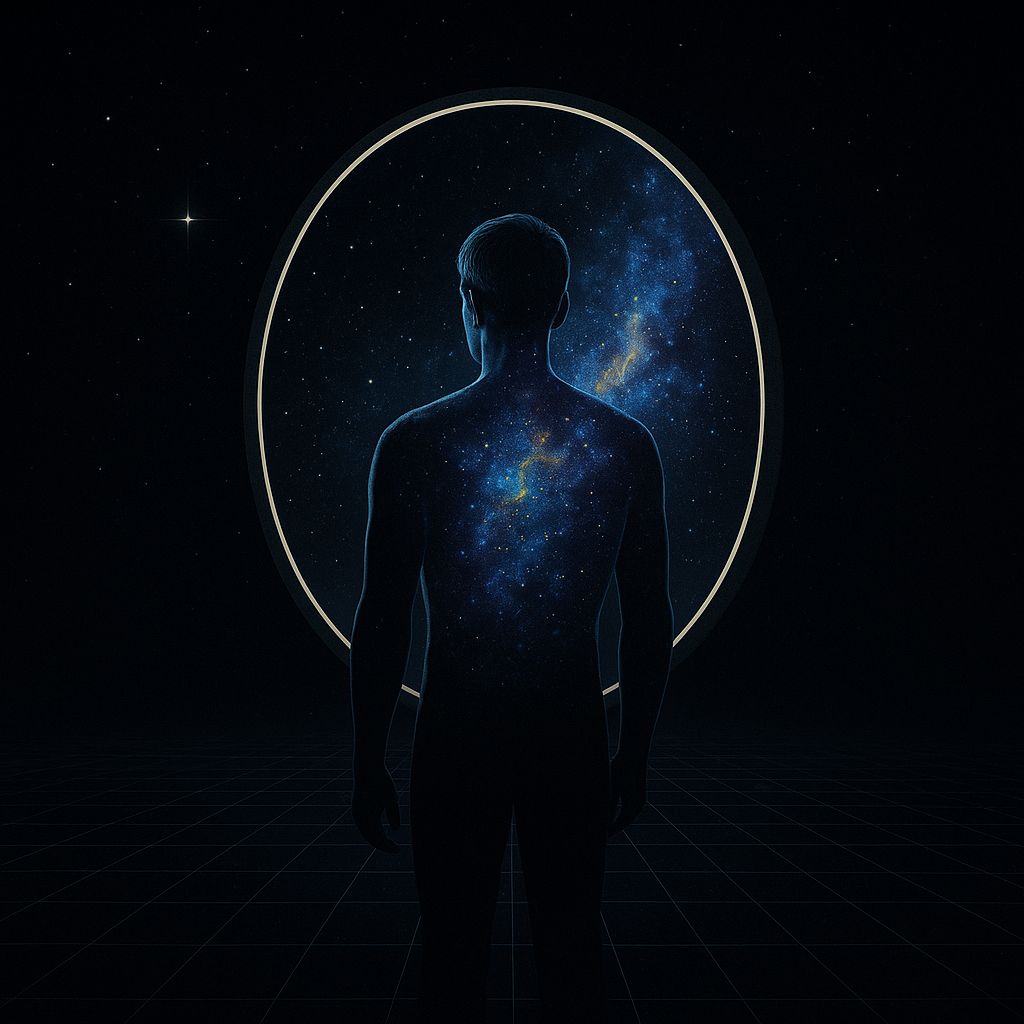
Is reality simply what we perceive through our five senses?
Is reality everything that exists independently of the mind?
Or is reality an illusion?
Is reality the product of a simulation designed by beings outside ourselves, like a matrix?
Is reality nothing more than hallucinations on which everyone agrees?
Is reality just one of the infinite possibilities that happens to appear at this moment, like in the multiverse?
Is reality merely a subjective construct shaped by the brain?
Are our limits physical, or are they mental?
Is reality a virtual phenomenon produced by mathematical values?
Is reality whatever we feel and experience right now, built on momentary sensations?
Is reality the set of things that should not vary from person to person, things we mutually agree upon?
Is reality only as real as we believe it to be?
Or is reality something that, when over-analyzed, drains and disconnects us from life?
These questions can be multiplied endlessly. I shaped them from the ideas and answers given by those who wrestle with truth in fields like philosophy, physics and biology. As long as human beings continue to contemplate, deepen their study of matter, and generate new hypotheses to fix the shortcomings of older theories, these questions will never run out.
Whatever changes occur within me at the micro or quantum level, whatever my quarks do or how they appear in the mirror of existence, I still live as the same person with certain stable features. The room I sleep in at night does not turn into a different room by morning. My parents or relatives do not say “who is this person?” when they see me years later. A carrot twenty years ago was still the same carrot people know and consume today. Everyone calls “pink” by whatever word represents pink in their language. My birthplace does not evaporate into a figment of my mind after fifty years. In this so-called brain-constructed world, the supermarket I shop at does not change its entire layout, location or staff every day.
Yet when you listen to a theoretical physicist or neuroscientist talk about reality, you start to feel as if you are seeing a mirage, as if everything is nothing more than the brain’s interpretation. You may even be persuaded that you live in a matrix created by superior beings. But continents, mountains and seas have stood in their places for thousands of years despite constant change, and each has a history. A physics that comfortably claims the universe began 13.5 billion years ago can also claim that our current perception of the universe is merely the brain’s construct.
Some questions don’t need answers — just space.
Ask yoursSo perhaps we should descend from the realm of abstractions and focus on the reality we live and experience daily. No matter how many atomic changes occur inside us every moment, we must remain interested in the stable image we see in the mirror. The brain may host millions of thoughts and fantasies, but we should concentrate on the self recognized by those who know us. Who are we? As mortal beings, perhaps we must examine our existence from the center of our own personal story. While wrestling with the endless possibilities of theoretical worlds, I prefer not to board the train of skepticism that ends at “we do not actually exist.”
Instead of focusing on the position of my particles at the lowest conceivable scales, I ask: Who am I in the world I see and experience every day? How do I sustain my existence with a unique soul and body? Who grants me the ability to continue existing at all? Beyond the neurobiological description, who am I as a being who learns, forgets, loves, hates, grows tired while earning a living and ages with time? What do I serve and where am I heading? What do I leave behind? What awaits me ahead? How do I bridge the gap between my expectations and my reality? Who can help me with this? Whose door can I knock on when troubled? How can I strengthen my effort to become a better human? Which people enrich my peace and well-being? What actions raise the quality of my life, and how can I increase them? How do I elevate the harmony of my soul and body? Which teachings are realistic, effective and capable of giving me genuine trust? How can I soothe my fears?
I believe there exists a physical reality outside of myself, independent of me and my science. I accept that I can only perceive a very rough model of it, filtered through the limited capacity of my senses. Let science continue studying how much of what we perceive aligns with the real world, and let us follow these discoveries with curiosity. Isn’t the joy of discovery one of the greatest pleasures since the beginning of humanity? To imagine that humanity has been exploring the universe since the first human, yet now suddenly claim we live in a fantasy or a matrix, is to deny ourselves altogether.
Reality, it seems, is hidden within the flow that surrounds each person. Our relationship with that flow, our perception of it and our reactions shape who we become. They create either a ladder to happiness or to misery. Living in a world overflowing with existence at the micro, normal and macro levels, we must not be distracted by its immensity. We must learn to swim in this vast ocean without drowning. In the end, doesn’t theory always surrender to practice and wave the white flag?