
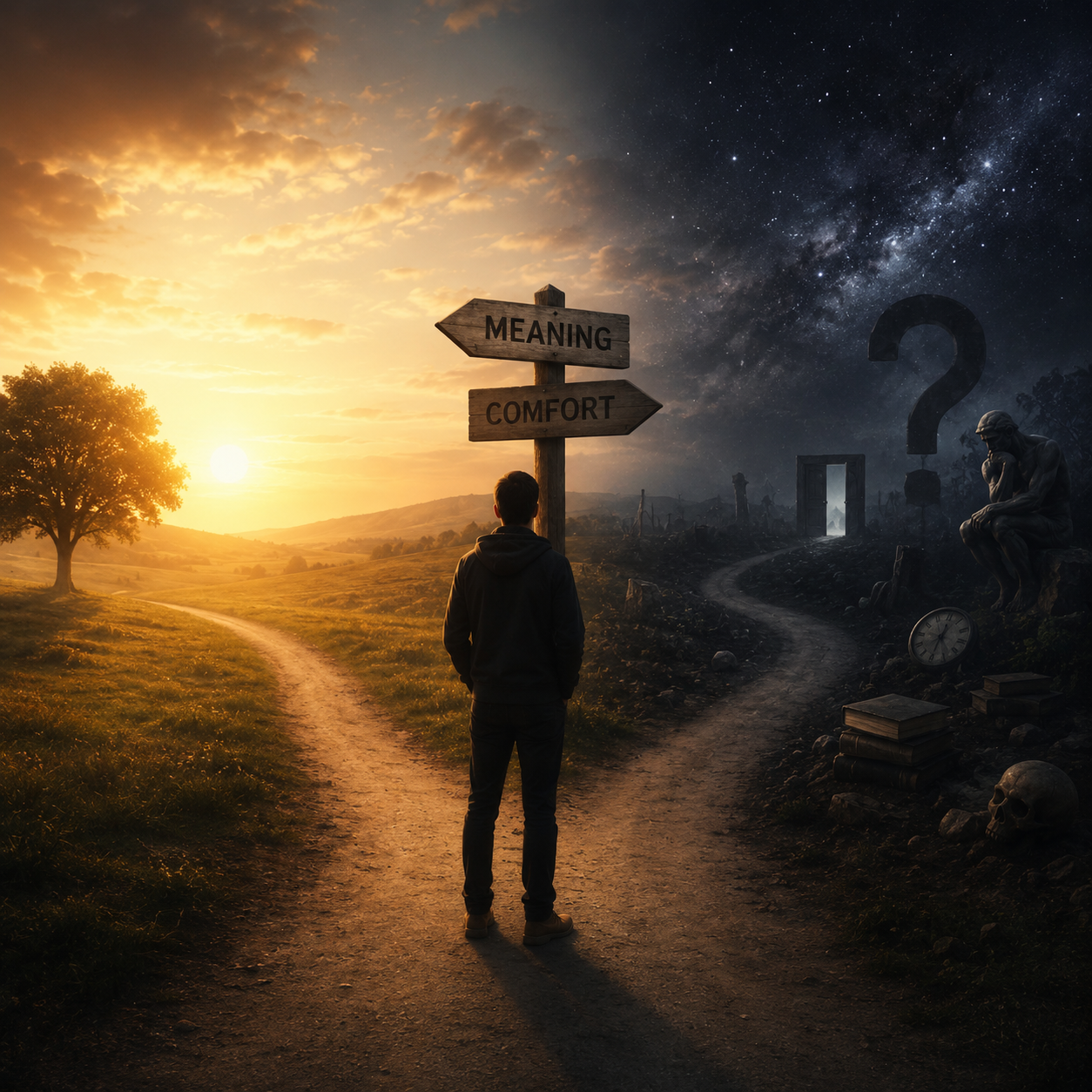
Sooner or later, every human being comes face to face with this question.
When we are young, we may not adopt a perspective that places death at the centre of our thoughts or leads us to question life itself. Yet as time passes, through events and experiences, we become increasingly aware of our mortality.
So how can a person live while knowing that they will one day die?
If we do not want to lose our sanity, perhaps we can live only by forgetting. Yet at the end of each day, a certain sadness settles over us, and death closes the scene by reminding us of its presence. There is an end, and each passing day seems to declare that we have moved one day closer to it.
By the time Leo Tolstoy reached his fifties, he had become famous for works that would take their place among the classics of world literature. He had achieved prosperity and was enjoying wealth, fame, and a peaceful family life. And yet, he fell into a profound depression.
In A Confession, his words reflect the dark period that followed his questioning of life:
“Today or tomorrow, sickness and death will come to those I love or to me — if they have not already come. Nothing will remain but decay and worms. Sooner or later, everything I have done will be forgotten, and I will no longer exist. Why, then, should I continue making any effort? ... How can a person fail to see this? And how can one continue living? That is what is astonishing. A person can live only while intoxicated with life; once sober, it becomes impossible not to see that it is merely a deception — an absurd deception. That is precisely the point: there is nothing amusing or humorous about it; everything is cruel and absurd.”
While struggling in despair, Tolstoy began to ask how other people dealt with the question of life’s meaning.
At first, he gave little importance to what he regarded as the ignorance of “the masses.” Eventually, however, he discovered that ordinary people possessed something he did not — something that enabled them to endure life’s questions and suffering: faith.
More specifically, they believed in something greater than life itself, something perhaps beyond the limits of human understanding. Such faith may be directed towards God or towards another conception of a greater power. Through belief in God, people find reassurance in the conviction that their existence has a purpose and a destination.
Yet because reason stood at the centre of Tolstoy’s worldview, he initially regarded the concept of God as irrational and therefore unacceptable. He found himself trapped within a cycle of rationalism that could offer him no satisfactory answer to the purpose of life.
From his perspective at that time, the rational conclusion of what he called “the cruelty of life” was suicide. Yet he could not bring himself to take that step, and this inability only deepened his despair.
Humanity’s Search for Meaning
From the moment human beings appeared on the stage of existence, they have searched for meaning.
Humanity has pursued this search through religion, philosophy, art, and science. Science is primarily concerned with explaining what exists and how existence operates, while religion and metaphysics seek meaning through the pursuit of ultimate truth.
But what is reality?
What is truth?
Are they the same thing, or are they different?
For the moment, we might approach the distinction in this way:
Reality is knowledge obtained or reached through the senses. Truth, on the other hand, is the refined knowledge or understanding reached after what we perceive through the senses has passed through the filters of reason and logic.
Meaning may exist in a purpose that transcends the individual.
Some questions don’t need answers — just space.
Ask yoursPeople who consider their lives meaningful generally believe that their lives possess purpose, coherence, and value. Yet the meaning of life is also one of the most deeply relative questions we encounter.
It can take different forms depending on the individual, their abilities, family environment, education, society, culture, and countless other influences.
For someone raised in great wealth, for example, money may carry very little meaning. For someone born into extreme poverty, however, earning enough money to survive may become a central purpose occupying much of life.
For someone educated to spread a religious faith, the meaning of life may lie in sharing that faith. For another person driven by intellectual curiosity, life may find its meaning in reading, thinking, learning, and discovery.
The Bigger Picture
The greater picture of meaning looks different to everyone.
It is also true that many people live without ever having the circumstances or opportunity to reflect deeply on such questions. Family, education, belief, and culture provide each person with a particular horizon through which they see life. That horizon becomes their “big picture.”
Yet perhaps the more important task is for each person to create meaning through what is expected of them and through the responsibilities they undertake.
A worker may find meaning in their work. A scientist may find it in an office or laboratory. A traveller may find it on the road, and a healthcare professional may find it in caring for others.
In this sense, a sense of duty gives human life meaning.
But beyond one’s profession, forming moral values and living according to them may be even more important to living a meaningful life. These values may come from religion, culture, education, or other sources that shape the individual.
Why Do We Need Meaning?
Other living creatures do not appear to search for a special purpose in life in the way human beings do. Their existence revolves largely around survival, nourishment, and reproduction.
In this sense, what we call “the meaning of life” is a human concept.
But do we actually need such a concept?
Human beings are different because we are conscious of the past, aware of the present, and capable of imagining the future. It is therefore natural that we search for purpose.
Why am I alive?
Where did I come from?
Where am I going?
These are questions that refuse to leave the human mind.
To what extent can evolutionary or materialist perspectives answer them?
“Enjoy life. Make the most of it. You do not need to define a greater purpose. Devote yourself to your work, your family, and humanity. Do the things that bring you joy. Fill your life with beautiful memories.”
Such advice may sound reasonable.
But how firmly is it grounded?
Can it truly satisfy both the material and spiritual dimensions of the human being?
And ultimately, can such answers provide a sufficiently meaningful and functional response to the questions that have followed humanity throughout its existence?