
Part II of the SourceOne Essay Series on Science, Meaning, and Reality
One of the most frequently repeated criticisms of religious belief is the so-called “God of the gaps” argument.
According to this critique, belief in God is nothing more than an appeal to ignorance. Whenever humans encounter a phenomenon they cannot yet explain, they insert God as a placeholder. As science advances and these gaps close, God is gradually pushed out of the picture.
At first glance, this argument sounds persuasive.
But upon closer examination, it rests on a misunderstanding of both science and belief.
What the “God of the Gaps” Argument Claims
The argument can be summarized simply:
If something cannot currently be explained by science, religious believers attribute it to God. As scientific explanations expand, the need for God diminishes. Eventually, when science explains everything, belief in God will disappear altogether.
In this framework, God functions as a temporary explanatory device, useful only in the absence of scientific knowledge.
The problem is that this is not how thoughtful belief has ever understood God.
A Misplaced Assumption
The “God of the gaps” argument assumes that God competes with scientific explanations.
In reality, classical theism does not place God where scientific knowledge ends. It places God at a deeper level altogether. God is not invoked to explain unknown mechanisms, but to account for existence itself, order, intelligibility, and meaning.
Some questions don’t need answers — just space.
Ask yoursScientific discoveries do not remove God from the picture. They describe the structure of the picture.
Science Explains More, Not Less
Ironically, as science progresses, it often deepens rather than eliminates philosophical and metaphysical questions.
Modern cosmology points to a universe with a beginning. Physics reveals laws that are remarkably precise and finely structured. Mathematics uncovers an underlying order that is not invented but discovered.
These insights do not answer why there is something rather than nothing, why laws exist at all, or why the universe is intelligible to the human mind.
The “gap” has not disappeared. It has shifted.
The Real Gap
The true gap is not in scientific knowledge.
It is in assuming that scientific explanation is the only kind of explanation that matters.
When belief in God is reduced to a placeholder for ignorance, both science and theology are misunderstood. Science is reduced to a metaphysical worldview, and belief is reduced to a superstition waiting to be corrected.
Neither reduction is justified.
A Category Error, Once Again
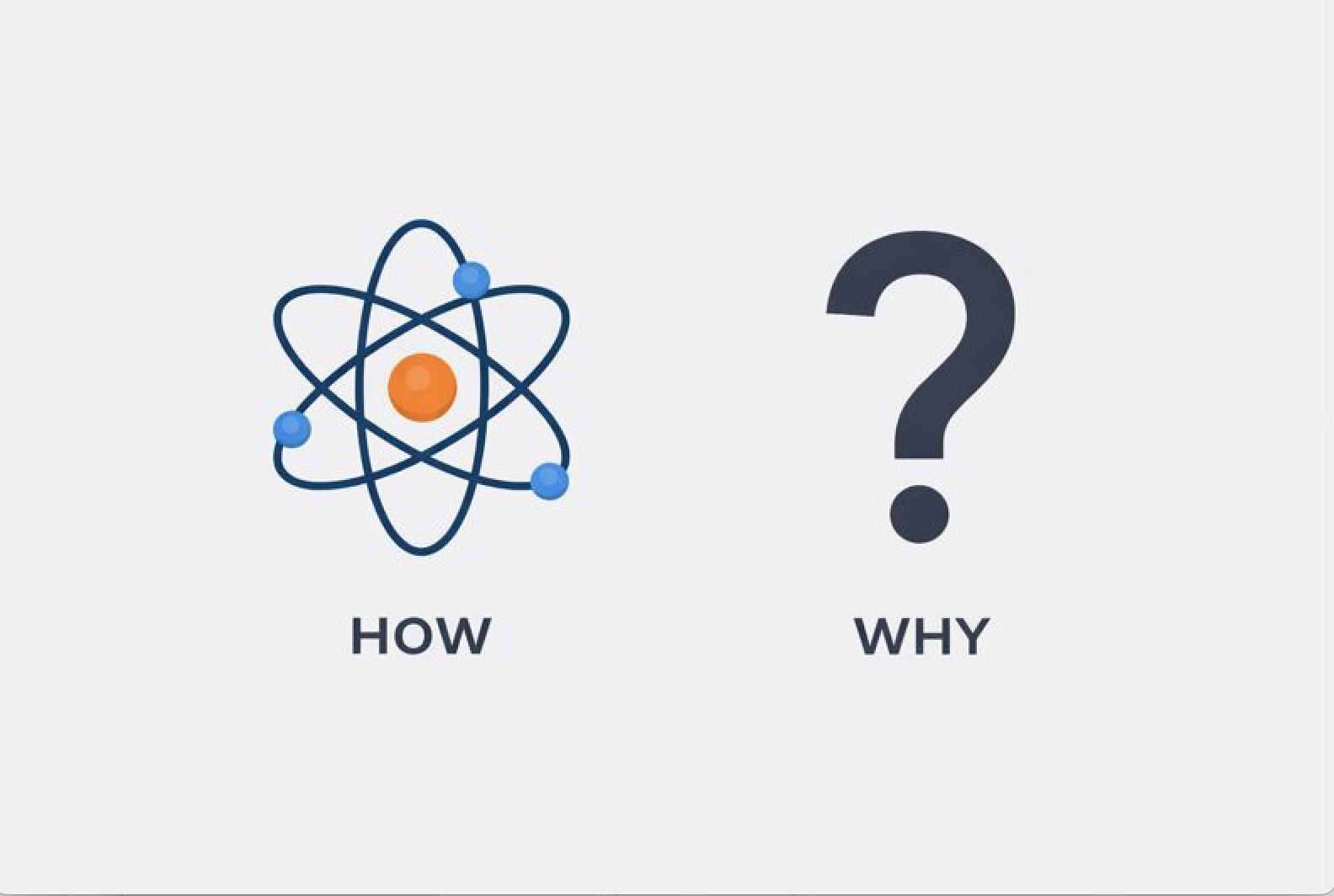
Just as science answers questions of how, belief addresses questions of why.
These domains are not rivals. They operate at different levels of explanation. Treating them as competitors creates a false conflict that benefits neither side.
The “God of the gaps” argument survives not because it is strong, but because it is simple. Reality, however, rarely is.
Next in the series:
Science Explains Processes, Not Ultimate Meaning